Beyond Conventional ADCs: The Emergence of Bispecific Antibody-Drug Conjugates (ADC 2.0)
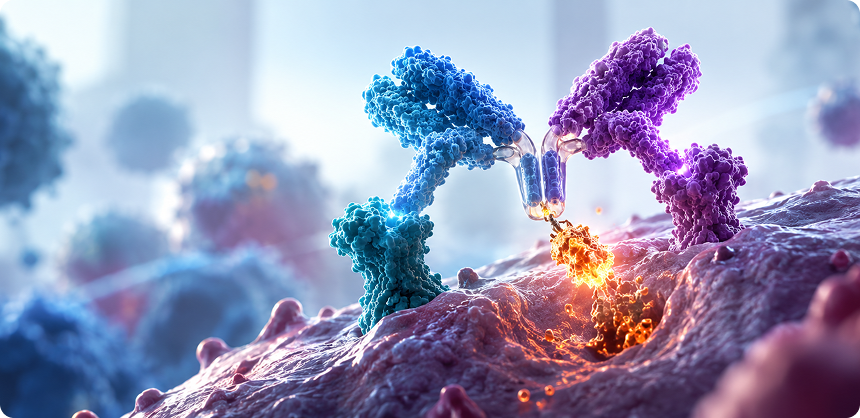
Antibody-drug conjugates (ADCs) have transformed the concept of targeted cancer therapy by combining the precision of antibody-based targeting with the potency of cytotoxic drugs. What began as an experimental therapeutic approach has evolved into a rapidly expanding modality, with successive advances in antibody engineering, linker technology and payloads broadening the potential of ADCs across multiple cancer types.
In June 2026, China's National Medical Products Administration (NMPA) approved iza-bren (izalontamab brengitecan), developed by Sichuan Biokin and SystImmune, making it the world's first approved EGFR×HER3 bispecific ADC for the treatment of metastatic nasopharyngeal carcinoma (NPC).
The approval was backed by the Phase III PANKU-NPC 01 (BL-B01D1-303) trial, which evaluated Iza-bren as a second-line therapy for recurrent/metastatic NPC.
This approval has quickly become one of the most talked about developments in oncology, not because another ADC has entered the market, but rather because it is the first-ever bispecific ADC to secure a regulatory approval anywhere in the world. Shortly after this, in July 2026, the same asset secured its second approval – this time in pretreated recurrent/metastatic extensive esophageal squamous cell carcinoma (ESCC).
These milestones are particularly exciting as they not only validate a novel approach to ADC design but also point towards the potential of bispecific ADCs to overcome some of the long-standing limitations of conventional ADCs, thus paving way for the next generation of targeted cancer therapies.
....But What Limitations of Traditional ADCs Necessitate Reinvention?
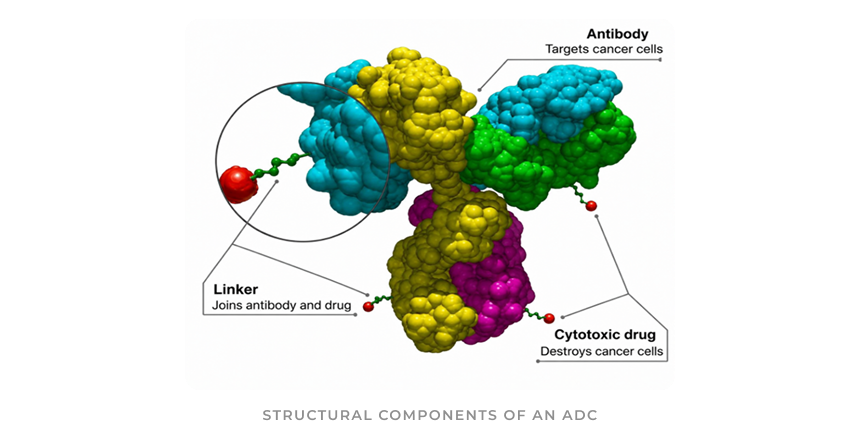
As of 2026, 18 ADCs had received regulatory approval for solid tumors and haematological malignancies. More than 400 ADCs are in development worldwide, including over 200 in clinical trials, reflecting the growing demand for targeted therapeutics and the role of ADCs as a promising approach in targeted cancer therapy.
Despite their clinical success, the conventional ADCs are designed to recognize only one tumor-associated antigen, creating a few important challenges:
Single-target design

Tumour killing depends entirely on one target being present.
Antigen loss & resistance

Cancer cells can lose or downregulate the single target, reducing ADC effectiveness.
Tumour heterogeneity

Not all tumour cells express the same antigen, allowing some cells to escape treatment.
Off-target toxicity

Non-specific payload release can affect healthy tissues, limiting treatment safety.
This is exactly where bispecific ADCs come into the picture.
Bispecific ADCs are engineered to tackle these challenges by recognizing two tumour-associated antigens simultaneously, offering a novel approach to targeted drug delivery.
Iza-bren (EGFR×HER3), demonstrates this approach through:
- Dual-target recognition (EGFR × HER3) for improved tumor selectivity.
- Reduced resistance through simultaneous blockade of two signaling pathways.
- High payload delivery with a drug-to-antibody ratio (DAR) of ~8.
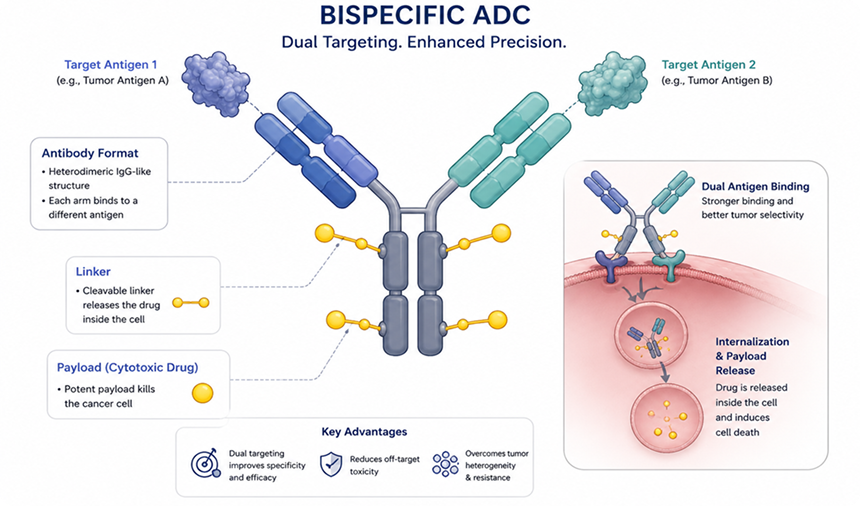
Let's Take a Look at How Bispecifics are Evolving
To date, Iza-bren is the only approved bsADC, while JSK-003, TQB-2102, and JSKN-016 are among the most clinically advanced candidates in the pipeline.
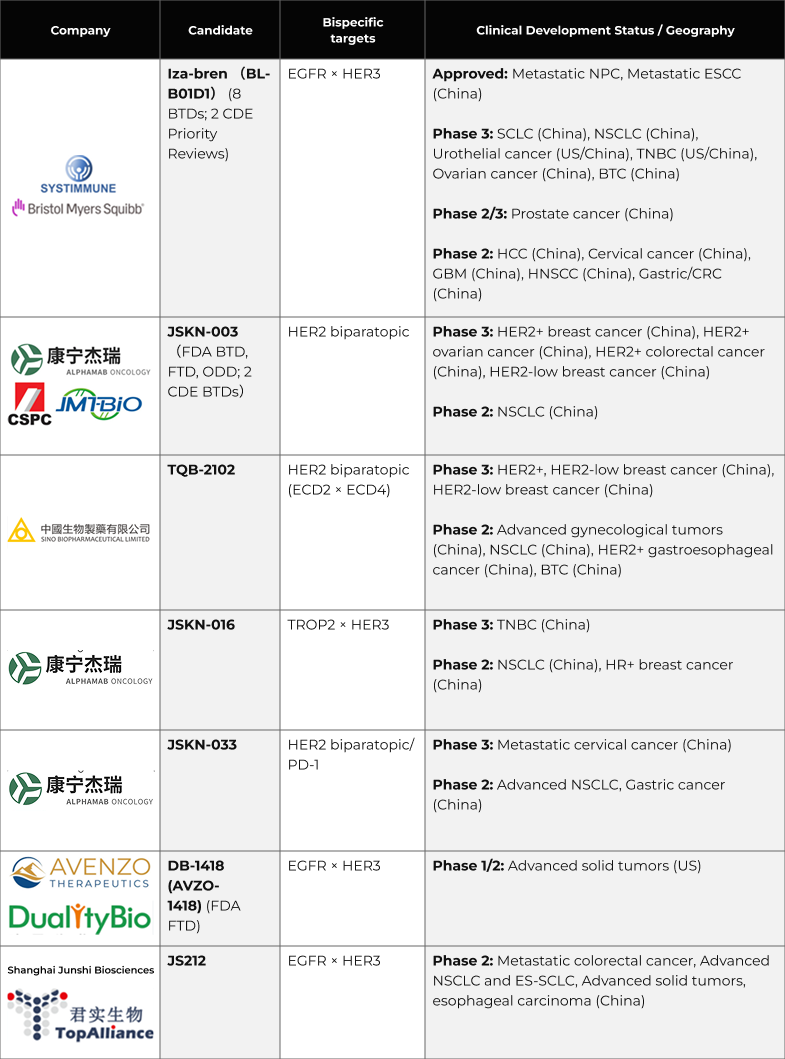
Note: The above list of assets is not exhaustive and showcases only late-phase assets (Phase 2 and above)
Abbreviations: NPC: Nasopharyngeal carcinoma; ESCC: Esophageal squamous cell carcinoma; SCLC: Small-cell lung cancer; TNBC: Triple-negative breast cancer; BTC: Biliary tract cancer; HCC: Hepatocellular carcinoma; GBM: Glioblastoma multiforme; HNSCC: Head and neck squamous cell carcinoma; CRC: colorectal cancer; NSCLC: Non-small cell lung cancer
“So What are the Key Learnings?....”
- From frontrunner to first approval, Iza-bren has become the world's first approved bsADC for NPC and is now advancing through 40+ clinical trials across multiple tumour types.
- China is emerging as the hub for bsADC innovation. The first approved bsADC, along with several late-stage clinical candidates, has come from Chinese companies, highlighting the country's growing role in next-generation ADC innovation.
- Large pharmaceutical companies are increasingly accessing bsADC innovation through strategic partnerships rather than developing these assets entirely in-house. Bristol Myers Squibb's (BMS) collaboration with SystImmune for Iza-bren reflect a broader strategy where global pharma are leveraging innovation from emerging Chinese biotech companies to strengthen their ADC pipelines while reducing early discovery risk.
- BMS is the only big pharma player that has a bsADC in Phase 3 development.
- Alphamab appears to be placing a strong strategic bet on bsADCs. With multiple bispecific and dual-payload ADCs progressing through clinical development, it's making a strong bet on the future of next-generation ADCs.
- HER2 seems to be the dominating target. Most clinical-stage candidates are built around HER2 and EGFR and paired with targets such as PD-L1 and TROP2, suggesting developers are building on an already validated target rather than moving away from it.
- The pipeline is heavily skewed towards solid tumors, with breast cancer and NSCLC emerging as the most frequently explored indications.
What's Next for Bispecific ADCs?
Combination therapies could be the next breakthrough.
Early programs such as Alphamab's JSKN033 are already combining bsADCs with PD-L1 checkpoint inhibitors to enhance anti-tumour responses.
Who will be the next approved bsADC?
Following Iza-bren's approval, JSK-003, TQB-2102, and JSKN-016 have emerged as leading contenders for the next regulatory milestone, with ongoing clinical studies expected to determine which candidate reaches the market next.
Overcoming molecular complexity will be key.
Scalable manufacturing without compromising product quality remains essential for wider clinical application.
Target diversification is likely to drive the next phase of innovation.
While EGFR × HER3 has achieved the first regulatory approval, newer programmes are exploring HER2 biparatopic designs, HER2 × PD-L1 and TROP2 × HER3 combinations, suggesting that developers are expanding beyond a single target pair to improve efficacy across different tumour type
Need to establish the long-term safety profile
The long-term real-world safety data is still sparse. These novel ADCs would need to prove their long-term utility in order to gain traction in the market
BsADCs are just one part of the next generation of ADCs.
While BsADCs seem exciting, these do not cater to the following limitations of ADCs:
- Payload-mediated resistance – Most bispecifics carry a topoisomerase I inhibitor. Resistance to a single payload like this cannot be overcome via single-payload carrying bispecifics
- Payload-class toxicity
- Antigen heterogeneity – Two antigens narrow antigen escape window but cannot fully close it
- Need for stable linkers with better release kinetics
- Off-tumor toxicity can be minimized but not completely closed
- Insufficient immune activation
- Poor tumor penetration
Most of these limitations could be addressed via Dual-payload ADCs, Probody ADCs, immune-stimulating ADCs (ISACs) and antibody-based protein degraders (Ab-PROTACs) and other upcoming ADC modifications that shall be discussed in the forthcoming articles of the ADC series
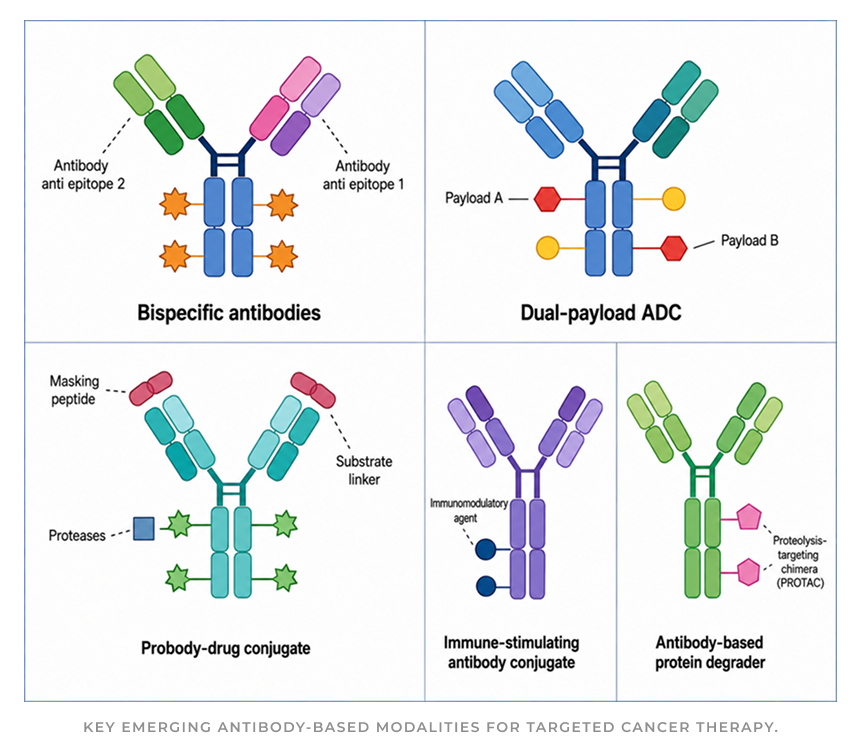
The approval of Iza-bren shows that next-generation ADCs are no longer just an emerging technology — they are beginning to reshape the future of targeted cancer therapy.
As more candidates advance through clinical development, bispecific ADCs and other next-generation ADC platforms have the potential to redefine precision oncology by improving tumour selectivity, overcoming resistance and expanding treatment options across multiple cancer types.
- Parveen I, Aqil A, Sharma S, et al. From Concept to Clinic: Cutting-Edge Advances Steering the Next Wave of Antibody-Drug Conjugates Innovation. Journal of Drug Delivery Science and Technology. 2026;108271. https://doi.org/10.1016/j.jddst.2026.108271
- Hao X, Wu X, Yang X, et al. Multi-specific antibody drug conjugate: The next frontier for solid tumors. Chemical Engineering Journal. 2026;529:173329. https://doi.org/10.1016/j.cej.2026.173329
- Fan Z. Bispecific antibodies for cancer therapy: evolution of structural mechanisms and co-targeting strategies from wet-lab to AI-driven in silico modeling. Cancer Letters. 2026.
- Four drugs race for first bispecific ADC approval. Pharmaceutical Technology. https://www.pharmaceutical-technology.com/analyst-comment/four-drugs-first-bispecific-adc-approval/
Prepared by PharmSight Research & Analytics for informational purposes only.