The Emerging Frontier: CAR-T Therapies in Autoimmune Disorders
For decades, autoimmune diseases have been managed rather than cured. Now CAR-T therapy, originally developed for blood cancers, is emerging as a potential game-changer, offering the prospect of a one-time treatment that resets the immune system and enables drug-free remission.

Reprogramming the Immune System
For decades, autoimmune diseases (where the immune system turns against the body's own tissues) have been managed rather than cured. Patients with conditions like systemic lupus erythematosus (SLE), systemic sclerosis, myasthenia gravis, and inflammatory myositis cycle through lifelong immunosuppression, often with diminishing returns and mounting side effects.
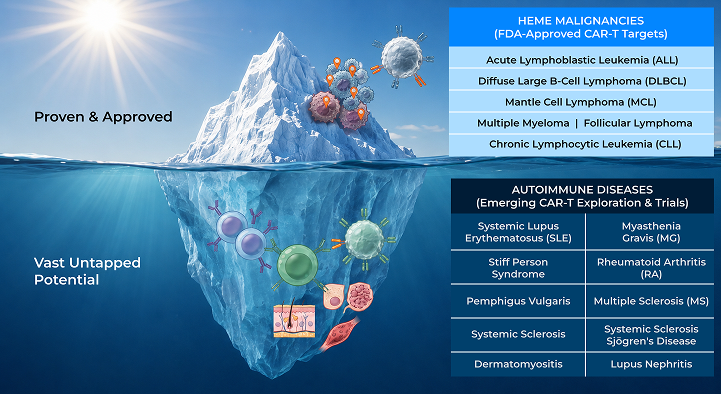
Chimeric antigen receptor T-cell (CAR-T) therapy, originally developed for hematologic malignancies, is now emerging as a potential game-changer for autoimmune diseases. By engineering patients' T cells to target and eliminate pathogenic B cells, CAR-T offers the prospect of a one-time treatment that resets the immune system, enabling drug-free remission.
Early clinical successes have largely been generated using CD19-directed CAR-T therapies, reinforcing confidence in this approach. However, CD19 is unlikely to remain the only target.
Beyond CD19
CD19-targeted, ex vivo autologous CAR-T is where this field started, but it is no longer the whole story. Five distinct engineering approaches are now in active clinical development, each trying to solve a different piece of the safety, cost or access puzzle.
| Modality | How it works | Lead example | Why it matters |
|---|---|---|---|
| Autologous CD19 CAR-Tex vivo | Patient's own T cells are engineered outside the body to target CD19-positive B cells, then infused after lymphodepletion | Kyverna's KYV-101, Cabaletta's CABA-201, Miltenyi's zamtocabtagene autoleucel | Most clinically mature route; deep evidence base (e.g. CASTLE study) |
| Allogeneic CAR-Toff-the-shelf, donor-derived | Healthy-donor T cells are pre-edited to limit rejection and graft-versus-host risk, then manufactured in advance as a ready-to-use batch product | Allogene's ALLO-329 (dual CD19/CD70) | Removes patient-specific manufacturing wait entirely; aims for same-day treatment and lower per-dose cost at scale |
| mRNA-engineered, transient CAR-T | T cells are transfected with mRNA rather than DNA, so CAR expression is self-limiting | Cartesian's Descartes-08 | Built for outpatient use; aims to lower CRS/ICANS risk versus permanent gene edits |
| In vivo CAR-TmRNA-LNP | Lipid nanoparticles deliver CAR-encoding mRNA directly into the body, programming T cells with no leukapheresis or lymphodepletion | AbbVie/Capstan's CPTX2309 | Could remove the manufacturing, cost and access bottlenecks that limit ex vivo CAR-T at scale |
| CAR-Treg / logic-gated Tregs | Engineered regulatory T cells suppress immune activity locally, often using AND/NOT antigen-gating for added control | Academic and early-stage biotech programs | Aims for localised immune modulation without depleting the B-cell pool |
In vivo CAR-T represents a potential platform disruption, analogous to how mRNA technology transformed vaccine development.
Early clinical data with CAR-Ts in the autoimmune space are highly encouraging, with many patients achieving complete serologic and clinical responses. As of January 2026, the field is accelerating, with registrational trials underway thereby raising the prospect of functional cures rather than lifelong disease management.
Growth of CAR-T Research in Autoimmune Disorders
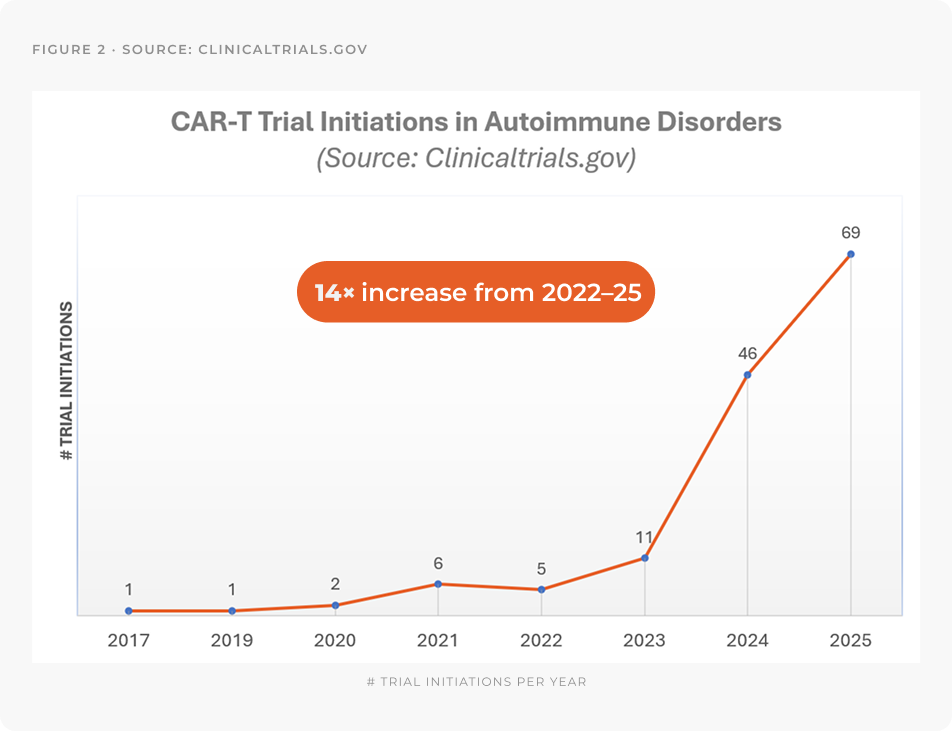
CAR-T trial initiations in the autoimmune space have surged exponentially, especially over the previous 3–4 years, from 5 trials in 2022 to approximately 70 trials in 2025 (a 14-fold increase) which indicating a shift in focus from a relatively crowded oncology domain to the less explored immunology domain.
Key Players Shaping the CAR-T Landscape
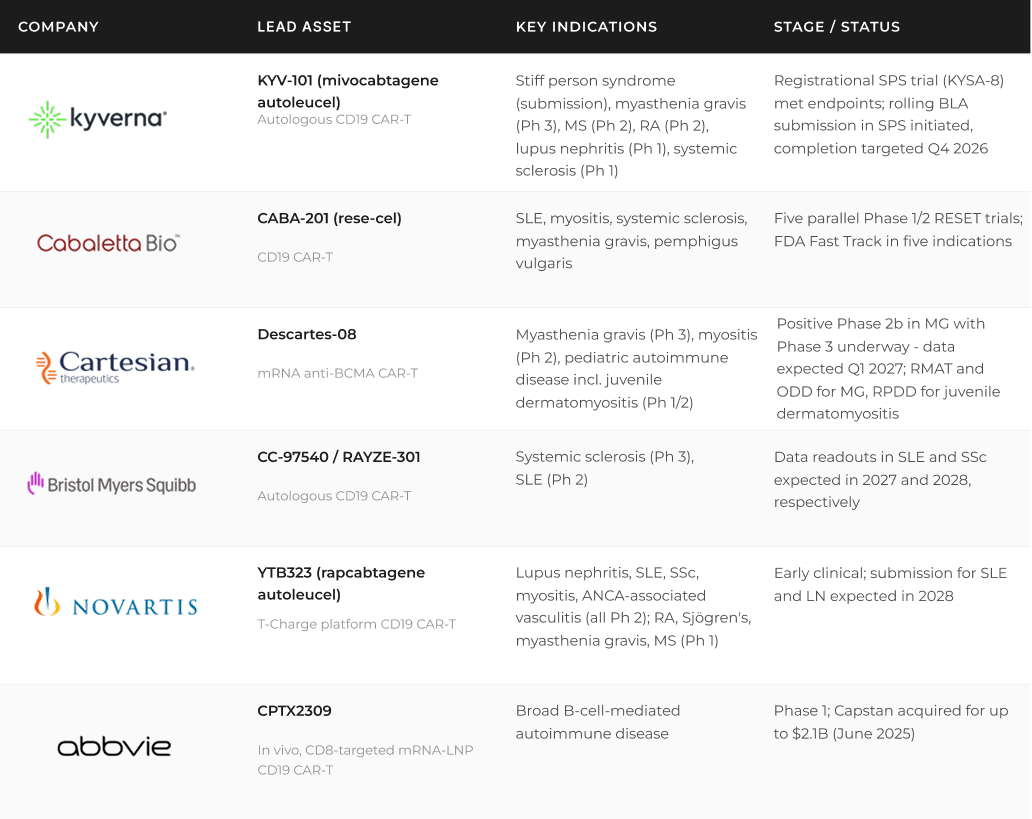
The roster of organizations active in this space has shifted from academic medical centers to a mix of focused biotechs and large pharma, often via acquisition rather than organic build.
Key Insights From the Landscape
- SLE, lupus nephritis, myasthenia gravis and myositis are some of the most common indications being evaluated for CAR-T therapies.
- Kyverna Therapeutics has emerged as one of the most visible pure-play developers focused on autoimmune CAR-T, with its stiff person syndrome program being submitted to regulators on a rolling basis. Myasthenia gravis is another key indication studied in a Phase 3 registrational trial.
- Using its proprietary NEX-T manufacturing platform, Bristol Myers Squibb is advancing CC-97540 (arlocabtagene autoleucel), designed to enhance cell fitness and reduce vein-to-vein time. Novartis' T-Charge platform differentiates itself by reducing total manufacturing time to under 2 days (vs. under a week for NEX-T).
- Cartesian Therapeutics is fundamentally disrupting the treatment paradigm with Descartes-08, a first-in-class mRNA-engineered CAR-T targeting BCMA. Because mRNA does not permanently integrate into the genome, it features transient expression, eliminating the risk of insertional oncogenesis and allowing outpatient administration without highly toxic lymphodepleting chemotherapy.
- Some large players such as AbbVie have struck deals with small biotechs to acquire their CAR-T therapies. The AbbVie–Capstan deal is the prospect of what large pharma sees this as more than a niche experiment: AbbVie paid a Phase-1, pre-data valuation for a platform explicitly built to sidestep the manufacturing and lymphodepletion burdens of conventional CAR-T.
Key Partnerships Driving Development
Besides AbbVie's acquisition of Capstan, several other partnerships and agreements have been made between pharmaceutical companies to augment and/or accelerate development of CAR-T therapies for autoimmune disorders.
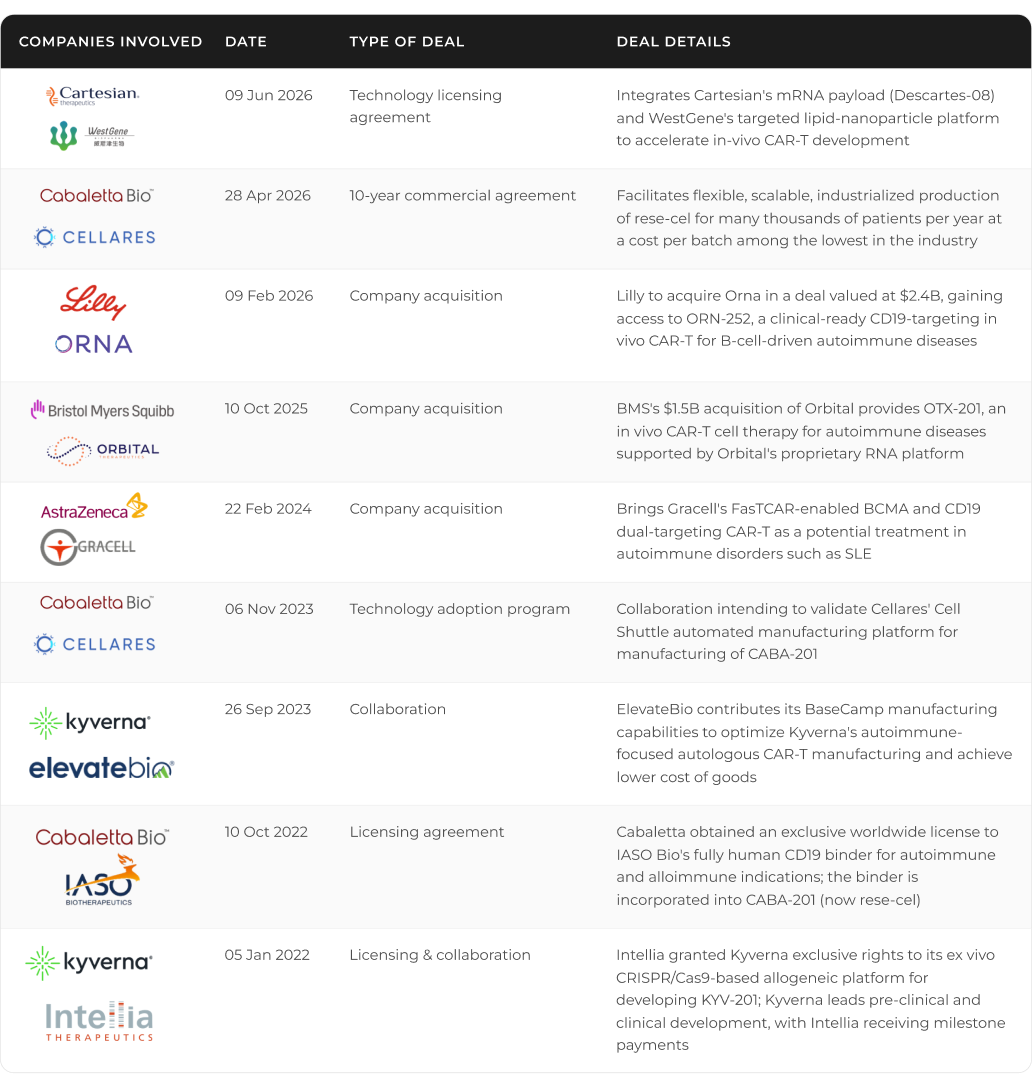
These deals demonstrate that big-pharma players such as Eli Lilly, BMS and AstraZeneca are increasingly focused on buying out small biotechs to enrich their pipelines with CAR-T assets. Moreover, the majority of recent deals center around in-vivo or allogeneic CAR-T therapies highlighting a trend away from autologous CAR-Ts.
Six Questions That Could Define the Use of CAR-Ts in Autoimmune Disease
The early data are encouraging but durability, patient selection, safety, manufacturing, economics and target biology all remain unresolved.
Is this immune reset truly durable?
Durability determines whether CAR-T will be viewed as curative, remission-inducing, or simply another expensive bridge therapy. The available follow-up is encouraging, particularly in lupus, but still too short and too small to establish how often relapse occurs, what relapse looks like biologically, and whether retreatment will be needed.
Which patients should receive CAR-T and when?
Today nearly all programs focus on severe refractory patients, sensible for early risk-benefit calculus. But the commercial inflection point comes only if CAR-T moves earlier, before years of cumulative organ damage, steroid toxicity and biologic cycling, where it can challenge entrenched standards of care rather than occupy a rescue niche.
How much toxicity is acceptable in non-malignant disease?
The early safety profile looks encouraging relative to oncology CAR-T, with most reported CRS low grade and fatal events uncommon in the published autoimmune literature. Still, autoimmune indications face a stricter bar: regulators, physicians and payers would tolerate far less neurotoxicity, prolonged cytopenia, infection risk and chemotherapy-related toxicity in non-cancer populations.
Can manufacturing become commercially viable?
Autologous CAR-T remains operationally heavy. Vein-to-vein time, product failures, center capacity, apheresis logistics and per-patient cost are all more problematic in broad autoimmune markets than in ultra-refractory blood cancers. This is why off-the-shelf approaches and alternative engineering strategies are strategically important: they are not merely technical improvements, but potential enablers of mainstream autoimmune adoption.
Will payers embrace a high-cost, one-time therapy?
The CAR-T economic model differs from chronic biologics. Although initial costs are high, long-term savings from lower disease activity, fewer hospitalizations, and reduced lifelong immunosuppression can change its value proposition. Robust health-economic evidence will be essential for broad reimbursement.
Lessons from low-income settings such as India could lower costs in the autologous space. India developed an indigenous CAR-T (talicabtageneautoleucel) and improved affordability through a Mango Sciences partnership offering 0% interest EMIs up to ₹10 lakh and a value-based payment of up to ₹10 lakh tied to outcomes for eligible patients.
What is the right target biology?
CD19 has led the field because of clear proof-of-concept, but it may not be sufficient in all diseases or all tissue compartments. BCMA-directed and dual-targeting strategies are gaining interest because plasma-cell biology, tissue-resident autoreactivity and disease-specific immunopathology may require more tailored depletion logic.
A First Approval Could Validate the Class
The next 3–5 years of CAR-T in autoimmunity could be driven by a first approval as proof-of-concept (for example, Kyverna's KYV-101 in stiff person syndrome in 2026–27) that would validate the class, streamline payer discussions, and expedite regulatory uptake for follow-ons.
Besides the questions discussed above, several others could take longer to answer:
- How will CAR-Ts fare on safety in a larger trial setting, and eventually in real-world usage?
- Will autologous CAR-Ts eventually be replaced wholly by newly-engineered modalities (allogeneic or in-vivo)?
- Will companies run head-to-head comparison trials between CAR-Ts?
- Will CAR-Ts be used sequentially with other modalities such as bispecifics in relapse or severe, refractory cases?
The answers to these questions could unlock new chapters in the CAR-T story as their development in the autoimmune space progresses.
Sources and Further Reading
- Müller, F. et al. CD19 CAR T-Cell Therapy in Autoimmune Disease - A Case Series with Follow-up. New England Journal of Medicine, Feb 2024. nejm.org
- Rangel-Peláez, C. et al. CD19 CAR-T cell therapy: a new dawn for autoimmune rheumatic diseases? Frontiers in Immunology, Dec 2024. frontiersin.org
- CAR-Ts for Autoimmune Disorders. DrxlerInsight blog. drxlerinsight.com
- Kyverna Therapeutics, May 2026 Presentation. ir.kyverna.com
- Kyverna Therapeutics Press Release, May 12, 2026. ir.kyverna.com
- AbbVie reels in Capstan in $2.1B buyout, charting course for in-vivo CAR-T market. Fierce Biotech, July 2025. fiercebiotech.com
- Cabaletta Bio pipeline page (accessed 30 Jun 2026). cabalettabio.com
- Miltenyi Biomedicine pipeline page (accessed 30 Jun 2026). miltenyibiomedicine.com
- Müller, F. et al. CD19 CAR-T cells for treatment-refractory autoimmune diseases: the phase 1/2 CASTLE basket trial. Nature Medicine, Jan 2026. nature.com
- Allogene Therapeutics Press Release, Jan 06, 2025. ir.allogene.com
- Cartesian Therapeutics pipeline page (accessed 30 Jun 2026). cartesiantherapeutics.com
- Kotamuri, L. et al. Safety and efficacy of CAR-T cell therapy in patients with autoimmune diseases: a systematic review. pubmed.ncbi.nlm.nih.gov
Prepared by PharmSight Research & Analytics for informational purposes only. Pipeline, trial and deal figures are drawn from published company disclosures, ClinicalTrials.gov and news sources as of July 2026, and should not be construed as medical or investment advice.