When a Correct KPI
Tells the Wrong Story
How to keep SFE reporting commercially reliable as targets, plans and operating models evolve

Commercial meaning is not held in a KPI formula alone. It also depends on the decision, population, plan, rule version and operating context around the number. A proportionate operating model can make those dependencies visible, test material changes and prevent dashboards and AI recommendations from carrying obsolete planning logic into current decisions.
When a correct KPI answers
the wrong question
A field team begins a commercial cycle with an approved list of 100 priority healthcare professionals. Its dashboard tracks priority-customer coverage: the percentage receiving a qualifying engagement. At a review point, 60 have been reached, so coverage is 60%.
Halfway through the cycle, 20 HCPs are removed and 20 are added. Fifteen of the removed HCPs have already been reached; five of the additions are then engaged. The latest list calculation now shows 50 of the current 100 targets covered: 50%. Nothing has been reversed in the activity record, and neither formula is inherently wrong. The 60% result asks whether the original commitment was delivered. The 50% result asks how execution stands against the revised list.
If the dashboard silently replaces the first question with the second, a correct KPI tells the wrong story. New targets appear uncovered before they were eligible; removed targets disappear from the commitment the team originally received. Managers may reconcile versions manually, build shadow spreadsheets or dispute results. Central teams may compare markets whose denominators, channel rules or plan versions are not genuinely aligned. One public vendor case describes competing report versions, home-grown field outputs and more than 50 spreadsheet reports in a large US pharmaceutical organization; it demonstrates that such burdens can exist, not how prevalent they are.1
The example is synthetic, but the design problem is real. Commercial conditions, HCP access and channel mix vary by specialty and market.2 Commercial models are also being asked to become more integrated and adaptive: a 2025 US study of 100 biopharma leaders and 12 executive interviews found that 56% believed the whole commercial function required significant change or full transformation, while only 30% felt well prepared for market trends.3 The implication is not that every KPI is unstable. It is that a measure needs an explicit way to retain its meaning when the planning and operating context around it changes.
A KPI is commercially reliable only while its calculation, context and permitted use still support the decision beside it.
Commercial meaning sits in the
planning-to-execution chain
SFE reporting is often treated as the final stage of a data process. Commercially, it is the final stage of a chain of decisions:

Each stage supplies assumptions to the measures that follow. The universe defines who could be considered. Segmentation identifies differences relevant to an objective. Targeting converts those differences into priorities. Engagement planning defines expected frequency, sequence and channel. Activity is judged against that context; observed response inherits it in turn.
The sequence is a planning-to-execution-and-learning loop, not a one-way hand-off. Engagement and field feedback may alter segmentation or targeting; access may change channel plans; response may redirect resources; and AI recommendations may modify priorities during the cycle. Learning can therefore change the context that later reporting must preserve.
The commercial meaning of a measure is therefore the decision-relevant interpretation created by six elements together: decision intent, calculation, eligible population, operating rules, valid time and permitted use. Semantic and metrics layers can centralize definitions; lineage and data products can clarify production and ownership; rule repositories can retain approved logic; model cards and FactSheets can document analytical assets; and decision-intelligence practices can improve how choices are framed.4, 5, 12, 13
Those controls explain definition, production and traceability. The additional question is whether the result remains valid for the decision now. This article uses Commercial Meaning Architecture sparingly as a descriptive label for an operating agreement that answers that question. It complements existing governance rather than replacing it, and it is neither a new discipline, a platform nor an established industry standard.
Where mature catalogues, lineage services, plan records, rule repositories or model inventories already exist, the proposed controls should reference them rather than duplicate them. A focused or emerging organization can begin with one decision and a controlled spreadsheet; a multinational can connect the same decision controls to its enterprise stack and governed local variations.
The controls form one operating loop: define the decision, measure, context, owner and authorized use; monitor material changes in planning, population, rules, ownership, data and models; revalidate affected outputs through the Decision Validity Check; explain whether movement came from execution, context or both; and act through the permitted reporting view, comparison status and expected action. The KPI Meaning Contract supports Define, dependency monitoring supports Monitor, the Decision Validity Check supports Revalidate, the descriptive KPI Context Bridge supports Explain, and the reporting view or AI Recommendation Passport supports Act.
Five controls for preserving
commercial meaning
The architecture develops the original five-control approach into a practical operating pattern. The controls can be implemented in a catalogue, workflow, governed spreadsheet or enterprise platform; the mechanism matters more than the product.
1. Define the decision
Start with the commercial question, decision owner, intended users and action that should follow. “Coverage” may inform coaching, resource allocation, current prioritization or leadership oversight. Those uses require different time bases and may justify different measures. If one number is forced to serve all four, ambiguity is designed in.
Decision logic is relatively stable, not permanently fixed. A launch may move from reach to depth, a model from HCP to account action, an objective from acquisition to retention, or an engagement plan from channel frequency to integrated sequencing. When the decision changes, close or version the previous contract, define the new owner and authorized use, and reassess which comparisons, KPIs and recommendations remain meaningful. The aim is to preserve decision meaning while it remains valid, not freeze an obsolete strategy.
2. Govern meaning through a KPI Meaning Contract
Mature KPI and metric catalogues may already contain detailed definitions, calculations, owners, sources and quality controls. A KPI Meaning Contract is not a replacement. It adds the decision the KPI supports, the period-valid commercial context, and the permitted use, comparison and action. It should link to existing catalogue entries, lineage, plan records and rule repositories rather than repeat them. The contract is a proposed artefact, not a recognized standard.
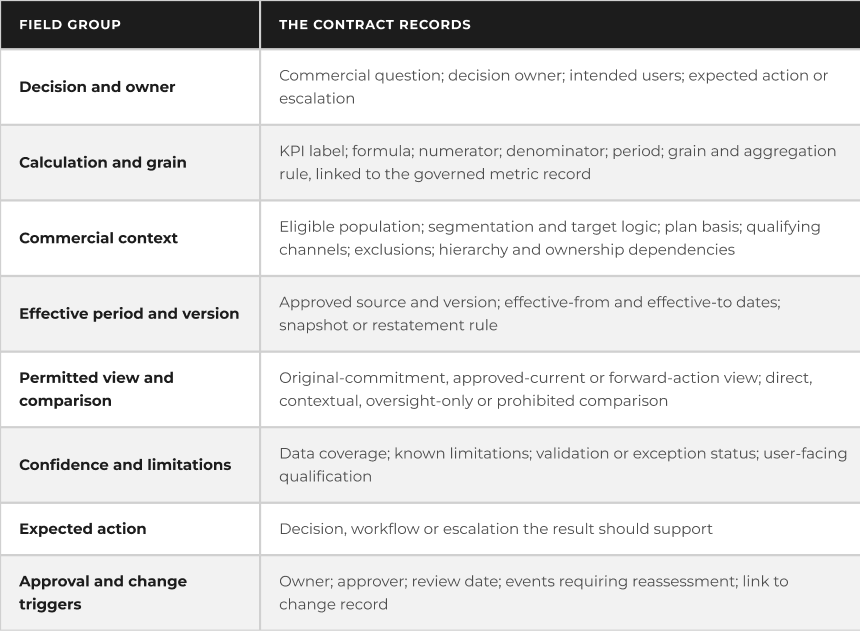
The contract should be short enough to use. A stable, low-risk activity count may need only a minimal set of controls. Incentives, resource allocation, ranking and AI-enabled decisions justify stronger population, version, confidence and comparison controls.
Make the dependency map active
A KPI or recommendation may depend on the customer universe, segmentation, target list, cycle plan, frequency expectation, channel rule, territory hierarchy, approved data source, model version, permission condition, decision and authorized use. Recording those links makes change impact visible. If illustrative segmentation version 4 is replaced by version 5, a dependency check might identify seven segment-dependent KPIs, three cross-market comparisons for review, recommendations generated under the earlier version and one incentive-linked measure that must retain version 4 for accountability. This is an operating illustration, not empirical client evidence.
The check should also identify unaffected outputs, the historical views to retain, comparisons to qualify, recommendations to reassess and actions to suspend. It can begin as a governed table or catalogue and later connect to metadata, lineage, rule-management or workflow systems. Provenance standards and event-based lineage specifications show that versioned dependencies and change events are technically representable; they do not establish this SFE application or its commercial impact.5, 17
3. Apply a Decision Validity Check when something material changes
Different changes need different expertise. Data teams may detect changes in coverage, quality or distribution. Model teams may test whether model behavior or performance has altered; concept-drift research provides one technical vocabulary for evolving data-generating relationships.6 Commercial owners must also detect changes in approved rules and planning assumptions, while decision owners must decide whether the user, action or acceptable risk has changed. The purpose here is not to create another drift taxonomy. It is to assess the decision consequence.
The proposed Decision Validity Check is a concise change-impact assessment applied when a material dependency changes or a result behaves unexpectedly.
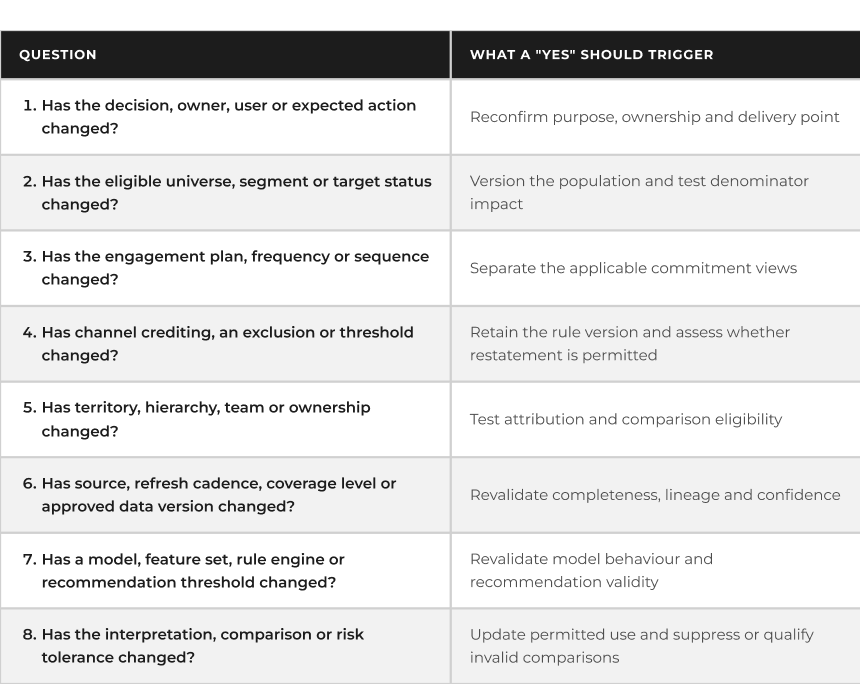
Useful triggers include a plan or segmentation refresh, a new product or channel, a hierarchy change, a model or data release, an unusual KPI step-change, repeated user overrides and a scheduled review. A “yes” does not automatically require redevelopment. A proportionate response may record no material impact, update the contract, create a new effective-dated version, recalculate a view, qualify or prohibit a comparison, expire and reassess a recommendation, or suspend a measure or action pending review.
Materiality is risk-based, not a universal percentage threshold. Low-consequence outputs such as inspectable local activity counts may need a minimal contract, periodic review and manual dependency tracking. Moderate-consequence uses such as coaching or current target decisions need versioned context, validity triggers, confidence and permitted use. High-consequence uses such as incentives, resource allocation, formal assessment, market ranking, AI prioritization or compliance-sensitive action justify stronger approval, effective dating, impact decomposition, active dependency monitoring, expiry or reassessment and auditability. The judgement should consider decision consequences, affected population, strategic segment, compliance sensitivity, financial or performance implications, reversibility and the speed at which an invalid output could influence action.
4. Use the decision view that matches the question
The clearest practical response to the target-list paradox is to recognise three legitimate views. The original-commitment view asks: did the team deliver what was agreed at the start of the period? The approved-current view asks: how is the team performing against formally approved revisions from their effective dates? The forward-action view asks: which current customers, accounts or priorities need attention now?
Do not force one denominator and time perspective to serve historical accountability, approved oversight and current action. In the synthetic example, original coverage remains 60/100, or 60%. Approved-current coverage is 50/100, or 50%, after accounting for the retained and newly added targets. Where customers enter the plan during the period, an approved-current performance view may also require an eligibility-from date, grace period or adjusted frequency expectation. The 50% result in this synthetic example is therefore a current-list coverage snapshot, not automatically a complete judgement of execution quality. The forward-action view is not necessarily a performance percentage at all: it may be a worklist of the 50 current-priority HCPs without a qualifying engagement.
A reliable dashboard should not only show that a KPI moved. It should explain how much of the movement came from execution and how much from changed commercial context. A proposed KPI Context Bridge can provide that explanation without creating another performance view.
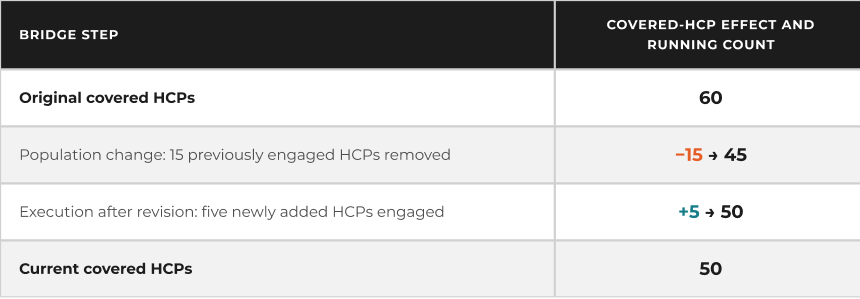
Because the list remains 100, the bridge reconciles 60% to 50%: the reported 10-point decline is a negative population effect partly offset by new engagement activity, not reversed field activity. This is deliberately simple count-based arithmetic. If denominators, weights, frequency requirements or eligibility periods also change, an agreed decomposition method is required rather than mechanical reuse of this bridge.
A compact channel-rule example shows why the rule version also matters. Suppose a plan contains eight expected engagements. Five face-to-face or phone contacts qualify under the original rule, and two digital engagements are also recorded. Before digital receives approved credit, attainment is 5/8, or 62.5%. Under the later approved rule it is 7/8, or 87.5%. Activity has not changed; commercial interpretation has. Comparing the two percentages as if performance improved by 25 percentage points would be inappropriate unless the rule change is made explicit.

Not every KPI needs all three views. A stable, low-risk measure may need one governed view. Historical reconstruction may be disproportionate or unreliable when earlier versions were not retained. Established approaches to historical dimensions and provenance demonstrate feasibility, while also showing why arbitrary point-in-time reconstruction can be burdensome.5, 7 Retain only the context the decision justifies: approved target and plan versions, effective dates, qualifying rules and ownership are often more useful than reconstructing every intermediate system state.
Multiple legitimate views should prevent false choices, not create an opportunity to select the most favorable result. Decision purpose determines the permitted view; the official accountability view and incentive treatment should be agreed before the period; approved-current changes need a named approver and effective date; and retrospective changes need explicit justification and visibility. Original and revised views should remain visible together where relevant, and forward action should not replace historical accountability.
KPI ambiguity is not always a technical accident. Stakeholders may reasonably favor different denominators, versions, exclusions or comparison rules. The Meaning Contract therefore needs an authorized business owner, view rules need approval, and changes need reason codes and effective dates. Disputes should be resolved as governance decisions, not silently in report logic. Documentation alone cannot reconcile conflicting incentives unless the process has authority.
5. Deliver the result where action happens
A reliable result needs visible context, confidence, ownership and a next step. In a dashboard, CRM workflow or review pack, show which view is being used, what changed, whether comparison is permitted and what the user should do. Public decision-support research outside pharma indicates that timeliness, completeness, task complexity and cognitive load affect decision quality or adoption intention; it does not prove an SFE outcome.8, 9
Comparison should therefore be selective. Results are directly comparable when decision intent, population logic, plan basis, channel treatment and confidence align. They are contextually comparable when the core measure aligns but operating differences must be displayed. A measure may be locally relevant but centrally visible for oversight without supporting a league table. It is unsuitable for comparison when logic conflicts or required context is missing.
AI recommendations are
the strongest stress test
AI-assisted targeting and next-best-action systems increase the need for this discipline because a recommendation can remain visible after the commercial assumptions beneath it have expired. Vendor material shows targeting, personalization and next-best-action as active commercial use cases, but public materials rarely establish industry prevalence or independent causal impact.10, 11 In Deloitte’s 2025 sample, 76% of respondents said siloed and outdated data infrastructure hindered their organizations even as leaders viewed AI as important to future commercial models.3
Consider a synthetic Segment A example. The system recommends a face-to-face follow-up; segmentation is refreshed; and the HCP moves to a lower-priority group. An active dependency check detects the changed segment version and changes the recommendation from valid to reassess. The user sees which dependency changed. The recommendation is then revalidated, recalculated or withdrawn under the approved rule.
The model may still be technically healthy. The recommendation became invalid because the commercial context changed. Model monitoring asks whether the analytical model performs as intended. Commercial revalidation asks whether this recommendation remains appropriate for the current decision. Both matter, but they are not interchangeable.
Model cards and AI FactSheets established the value of documenting intended use, performance, limitations, provenance and lifecycle facts.12, 13 NIST’s voluntary AI Risk Management Framework likewise emphasizes context of use, human oversight, documentation, deployment-relevant evaluation and production monitoring.14 An SFE AI Recommendation Passport references that enterprise governance but applies it to the individual recommendation or decision instance.
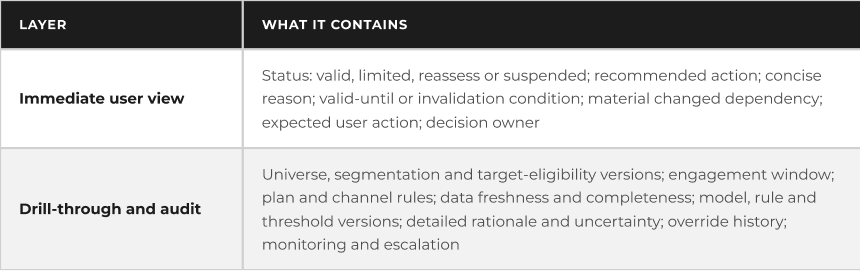
AI recommendations have a commercial shelf life.
That shelf life follows material dependencies, not a universal number of days. A recommendation may become limited, require reassessment or be suspended when its target loses eligibility, the commercial objective or segment changes, the recommended engagement is completed, a plan or channel rule changes, consent or contact permission changes, a material data or model release occurs, or an approved review condition is reached. The primary interface should show only what the user needs to decide safely; the fuller passport belongs in drill-through or audit.
In pharma, validity also depends on role, market, channel, contact permissions, privacy and data-use limits, promotional or non-promotional responsibilities, approved content and local exclusions. For example, the 2024 ABPI Code distinguishes promotional and non-promotional contexts, requires prior permission for promotional emails, and sets certification, audience and other requirements for relevant promotional material in the UK; GDPR separately establishes lawful-processing, purpose-limitation, data-minimization and accuracy principles for personal data in its scope.16 These sources illustrate why permissions and restrictions belong in the validity check. They do not form a global rulebook, and this article is not regulatory or legal advice: requirements differ by market, role and use case.
Human oversight must also be designed, not asserted. The field user should know what judgement remains theirs; the commercial owner should know when repeated overrides indicate a rule or context problem; analytics should know whether the recommendation failed technically or ceased to be commercially valid. Research on AI-advised decisions cautions that explanations alone do not consistently produce appropriate reliance and can sometimes increase over-reliance.15 A plausible narrative is not a substitute for current provenance, a validity check and accountable human choice.
Measure AI value as a decision chain
Counting recommendations or clicks is not enough. A proportionate measurement ladder separates seven questions:
- Technical delivery: was the recommendation generated, available and timely?
- Commercial validity: did it use the approved population, plan, rule and version for the decision?
- Adoption: did the intended user see or open it?
- Influence: was it accepted, modified or rejected, and did it change the user’s decision?
- Execution: did the intended action occur within the relevant window?
- Outcome association: was execution followed by an engagement or commercial outcome, with alternatives and limitations made explicit?
- Causal contribution: where the investment decision justifies it, did an experiment or credible quasi-experimental design estimate incremental impact?
This ladder is a proposed measurement logic. It separates availability from value, adoption from appropriate reliance, execution from outcomes, and association from causation. Not every AI use case needs all seven levels. A coaching aid may reasonably be assessed through understanding, influence and execution; a scaled investment case may require experimentation or a credible quasi-experimental design. Neither pathway, by itself, demonstrates sales causation.
Start with one decision, not
an architecture program
A first implementation should select one consequential decision, one or two high-risk KPIs, one known context change and, where relevant, one AI recommendation. This keeps the work tied to a real decision rather than an architecture program.
Three implementation levels
Level 1 - documented.
Dependencies and Meaning Contracts are maintained manually; approved versions and effective dates are retained; validity is checked at planned reviews or known changes. This can suit focused organizations, lower-risk measures and controlled spreadsheets.
Level 2 - monitored.
Material changes trigger alerts; impacted KPIs and recommendations are identified; validity, confidence and comparison status are reviewed; and users see what changed. This can suit growing organizations and higher-consequence decisions.
Level 3 - event-driven.
Approved changes automatically flag dependent outputs; recommendations can move from valid to reassess or suspended; and views are recalculated or qualified under governed rules. This can suit high-frequency, larger-portfolio or AI-enabled workflows where the benefit justifies the complexity.
These are implementation levels, not a universal maturity score. Different decisions may use different levels; event-driven control is not automatically economical; and consequential commercial or compliance decisions still require human approval.
What the first implementation produces
The first implementation should produce:
- One KPI Meaning Contract
- One planning-to-execution dependency map
- One materiality classification
- One Decision Validity Check trigger list
- One agreed three-view rule
- One KPI Context Bridge for a meaningful period change
- One user-facing validity and permitted-use treatment
- One AI Recommendation Passport where AI is in scope
- One named owner, approver and review process
Not every low-risk KPI needs all nine. The outputs can live in a controlled spreadsheet, metric catalogue, CRM workflow, existing BI model or enterprise governance service. The result is an operating agreement, not a mandated technology stack.
The model may be disproportionate where populations and rules are stable, decisions are low consequence or a tool is short-lived. Historical reconstruction may be speculative where versions were never retained; high-frequency decisioning may favor material-event snapshots over exhaustive capture. Existing CRM, warehouse and BI capabilities may already cover much of the requirement. The controls should reduce decision ambiguity, not add reporting burden.
What this changes in practice
The intended benefits are practical, not claims of proven return: fewer disputes and manual reconciliations; a clear separation between historical accountability and current action; faster, controlled accommodation of plan and rule changes; more defensible local, central and cross-market reporting; less duplicated logic; visible limitations and permitted use; and safer AI-assisted prioritization. The article does not demonstrate that these controls improve sales or generate ROI.
Commercial Excellence
leadership diagnostic
Leaders can test one consequential measure or recommendation with seven questions:
- What decision does it support, who owns that decision and what action should follow?
- Which population, segment, target, plan, channel rules and exclusions give it meaning?
- Which approved versions were valid for the period or recommendation instance?
- What changed since the result or recommendation was generated?
- Which view and comparisons does it legitimately support, and with what confidence?
- What should the user see, decide or escalate when meaning changes?
- How will value be distinguished from availability, adoption and mere outcome association?
If those questions cannot be answered, the immediate need may not be a more advanced dashboard or model. It may be to reconnect commercial planning, measurement and action so SFE can adapt without quietly changing what its numbers and recommendations mean.
The next generation of
reliable SFE reporting
The correct-KPI paradox is not resolved by choosing 60% or 50% as the single truth. It is resolved by making the decision view explicit, monitoring the dependencies that give it meaning, detecting material change, explaining execution versus context, and revalidating measures and recommendations before they influence action. The KPI Meaning Contract, Decision Validity Check and AI Recommendation Passport support that progression without requiring full automation for every organization.
A scalable reporting model does more than preserve definitions. It knows what each output depends on, shows why it changed and makes its decision-validity status visible before the user acts. A practical starting point is one consequential measure or recommendation: test whether its decision, context, version, confidence, movement and authorized use are clear.
- ZS, Rethinking reporting for commercial operations in pharma, undated public case study. Single vendor-authored US example involving a top-10 pharmaceutical company and more than 7,000 field users; supports existence and plausibility, not prevalence or causal impact.
- Veeva Systems, Veeva Pulse Field Trends Report, Q1 2024, May 2024. Proprietary CRM-system benchmark using activity from January 2023 to March 2024; its US access findings and vendor analysis should not be generalised to every market. See also IQVIA, ChannelDynamics Global Reference 2026, 19 June 2026, based on more than 30,000 HCPs; full methodology was not available in the reviewed public material.
- Deloitte Center for Health Solutions, Navigating the future of commercial in biopharma, 3 June 2025. Survey fielded in November 2024 among 100 US biopharma leaders from 77 companies, plus 12 interviews. Findings are directional and do not establish the prevalence of commercial-meaning failures.
- Snowflake, Overview of semantic views, accessed 16 July 2026, and dbt Labs, dbt Semantic Layer, updated 14 July 2026. Vendor documentation used to describe centralised metric-definition capabilities, not independent evidence of business outcomes.
- W3C, PROV Overview and PROV-O: The PROV Ontology, 2013 recommendations and note. Foundational provenance specifications used to establish traceability concepts, not an SFE implementation prescription.
- Fabian Hinder, Valerie Vaquet and Barbara Hammer, One or two things we know about concept drift - a survey on monitoring in evolving environments. Part A: detecting concept drift, Frontiers in Artificial Intelligence, 2024. Peer-reviewed technical survey focused on unsupervised monitoring; used only to distinguish changes in data-generating relationships from the commercial-rule and decision changes discussed here.
- Ralph Kimball, Slowly Changing Dimensions Are Not Always as Easy as 1, 2, 3, March 2005, and Slowly Changing Dimensions, Part 2, September 2008. Older foundational guidance retained only for feasibility, historical-view distinctions and proportionality.
- Hjelle et al., Organizational decision making and analytics: An experimental study on dashboard visualizations, Information & Management, 2024. Peer-reviewed experiment, n=524; not pharma or field-force research.
- Corentin Burnay, Mathieu Lega and Sarah Bouraga, Business intelligence and cognitive loads: Proposition of a dashboard adoption model, Data & Knowledge Engineering, volume 152, July 2024. Early experiment and structural-equation analysis, n=167; examines adoption intention, not observed long-term use, and is not pharma-specific.
- Axtria, Dynamic Targeting: Five Pillars of Implementation for Pharma Sales Force Effectiveness, 2024. Vendor implementation brief used to establish operational framing, not prevalence or independent outcome evidence.
- IQVIA, Next Best Action fact sheet, 2025, and Start with the Patient, June 2026. Vendor product and thought-leadership material used to show current use-case framing; public methodology does not substantiate broad adoption or outcome claims.
- Margaret Mitchell et al., Model Cards for Model Reporting, FAT 2019. Foundational peer-reviewed proposal for documenting intended use, evaluation and limitations; not pharma-specific.
- Matthew Arnold et al., FactSheets: Increasing trust in AI services through supplier’s declarations of conformity, IBM Journal of Research and Development, 2019. IBM-authored framework used for purpose, performance, safety, security and provenance concepts.
- NIST, Artificial Intelligence Risk Management Framework 1.0 Core, 2023, and Generative Artificial Intelligence Profile, NIST AI 600-1, July 2024. Voluntary cross-sector guidance, not a pharma-commercial standard.
- Raymond Fok and Daniel Weld, In search of verifiability: Explanations rarely enable complementary performance in AI-advised decision making, AI Magazine, 2024. Review of human-AI decision research; not conducted in an SFE setting.
- Prescription Medicines Code of Practice Authority, 2024 Interactive ABPI Code of Practice, including Clauses 1, 8, 15, 16 and 26. The 2024 Code came into operation on 1 October 2024, with transitional arrangements for newly introduced requirements through 31 December 2024. European Union, Regulation (EU) 2016/679 (General Data Protection Regulation), especially Article 5. Primary UK industry-code and EU legal sources used to illustrate market- and scope-specific controls; they are not a global compliance standard or legal advice.
- OpenLineage, About OpenLineage and Object Model, accessed 16 July 2026. Primary open-standard documentation used to establish that lineage metadata and runtime or design-time change events can be represented; it does not evidence adoption in pharma SFE or commercial impact.
This revision reviewed the approved article’s evidence base and additional public material spanning pharma-commercial conditions and AI use cases, semantic and metric layers, provenance and lineage, historical versioning, drift, model documentation, AI risk management and human-AI decision support. Priority was given to 2024-2026 material; older sources were retained only where they remain foundational.
Public evidence supports changing and heterogeneous commercial conditions, the existence of dynamic targeting and next-best-action use cases, the practical capabilities of semantic layers, provenance and historical versioning, and established principles for documenting and monitoring AI. It supports the plausibility of manual reconciliation and report proliferation through individual cases more strongly than their industry-wide prevalence.
The operating loop, active dependency treatment, KPI Meaning Contract, Decision Validity Check, descriptive KPI Context Bridge, three-view application, implementation levels, AI Recommendation Passport and seven-level measurement sequence are evidence-informed synthesis and proposed recommendations. They have not been validated through practitioner interviews and are not represented as established industry standards or recognized maturity models. The target-list, dependency, channel-credit and AI recommendation examples are synthetic. No confidential client evidence is included. The article does not claim that these controls improve sales, that event-driven validity has proven commercial impact, that automation removes human judgement, that every organization needs full historical reconstruction, or that every measure needs the full control set.
Practitioner validation is the recommended next step before positioning the framework as a proven consulting methodology.
Prepared by PharmSight Research & Analytics for informational purposes only. It does not constitute medical advice.