Beyond Weight Loss: The Next Chapter of GLP-1 Therapies
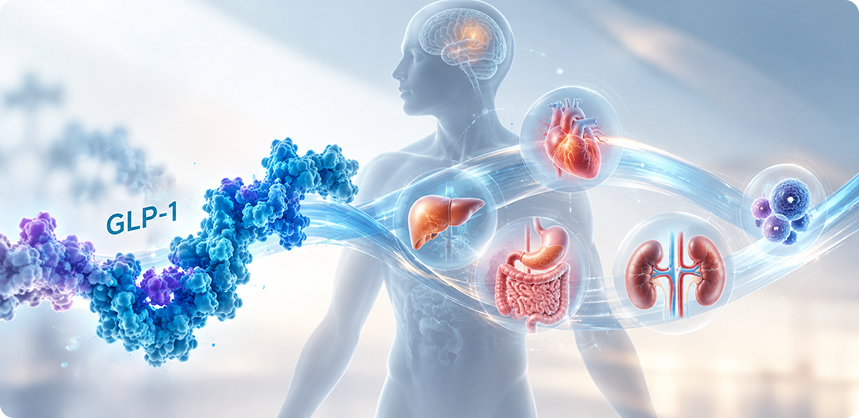
Glucagon-like peptide-1 receptor agonists have transformed the treatment of type 2 diabetes and obesity, becoming one of the most influential drug classes in modern medicine. Their success has sparked growing interest in exploring their potential far beyond metabolic disease. Nowadays, companies are evaluating GLP-1 therapies across cardiovascular, liver, kidney, neurological, and addiction-related conditions, reflecting a broader shift toward multi-organ therapeutics.
What is a GLP-1 agonist?
GLP-1 RAs mimic the naturally occurring incretin hormone glucagon-like peptide-1 (GLP-1). They stimulate glucose-dependent insulin secretion, suppress glucagon release, delay gastric emptying and promote satiety.
- Glucose-dependent insulin secretion
- Suppressed glucagon release
- Delayed gastric emptying
- Satiety
The result is better glycaemic control and weight loss, which made them highly effective therapies for type 2 diabetes and obesity.
Why did GLP-1 agonists become prominent in Obesity and Diabetes?
The growing global burden of diabetes and obesity created a significant unmet need (Fig. 1).
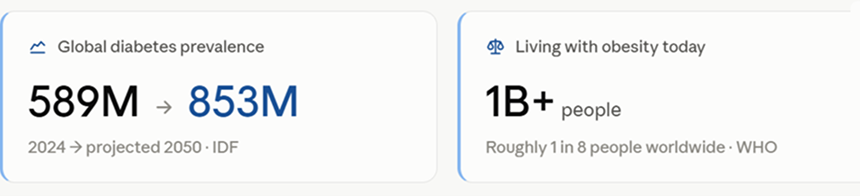
Fig 1 · Global diabetes & obesity data
Traditional treatment options often required multiple medications, produced modest weight loss, and did not adequately address the broader metabolic risks associated with these chronic conditions. GLP-1 RAs changed this paradigm by improving glycaemic control and delivering clinically meaningful weight loss with a single therapy.
Novo Nordisk's semaglutide led the class, as Ozempic for type 2 diabetes and as Wegovy, the first once-weekly GLP-1 RA approved for chronic weight management.
Eli Lilly's tirzepatide, the first FDA-approved dual GIP/GLP-1 receptor agonist, followed as Mounjaro for type 2 diabetes and Zepbound for chronic weight management.
Their success raised a bigger question: what else could these drugs do?
The Evolution of GLP-1s: Moving Beyond Weight Loss
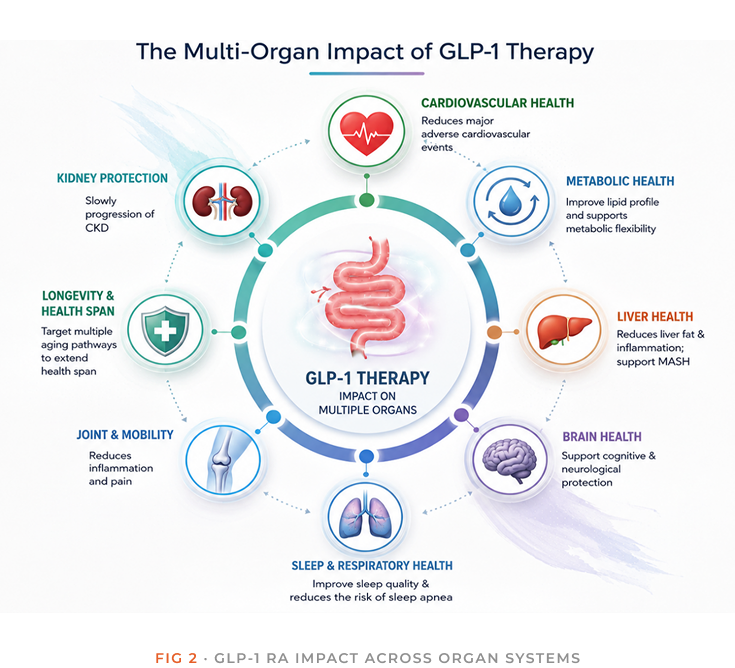
The answer starts with biology. Clinical evidence suggests GLP-1 receptors are also expressed in the heart, liver, kidneys, brain and immune cells, where they may influence inflammation, cellular metabolism and organ function. That biology has already translated into a few key label expansions for approved GLP-1s:
Cardiovascular disease (CVD)
In SELECT trial, semaglutide cut major adverse cardiovascular events (MACE) by 20% in people with obesity and established cardiovascular disease but no diabetes, making Wegovy the first anti-obesity therapy approved to reduce cardiovascular risk.
Metabolic dysfunction-associated steatohepatitis (MASH)
In ESSENCE trial, semaglutide resolved MASH without worsening fibrosis in 62.9% of patients, earning accelerated approval in MASH.
Chronic kidney disease (CKD)
In FLOW trial, semaglutide reduced the risk of major kidney disease events by 24%, leading to its approval in CKD patients with type 2 diabetes.
Obstructive sleep apnea (OSA)
In SURMOUNT-OSA trial, tirzepatide significantly reduced sleep apnea severity (apnea-hypopnea index), making Zepbound the first FDA-approved medicine for moderate-to-severe OSA in adults with obesity.
The Clinical Race: Upcoming Emerging Indications
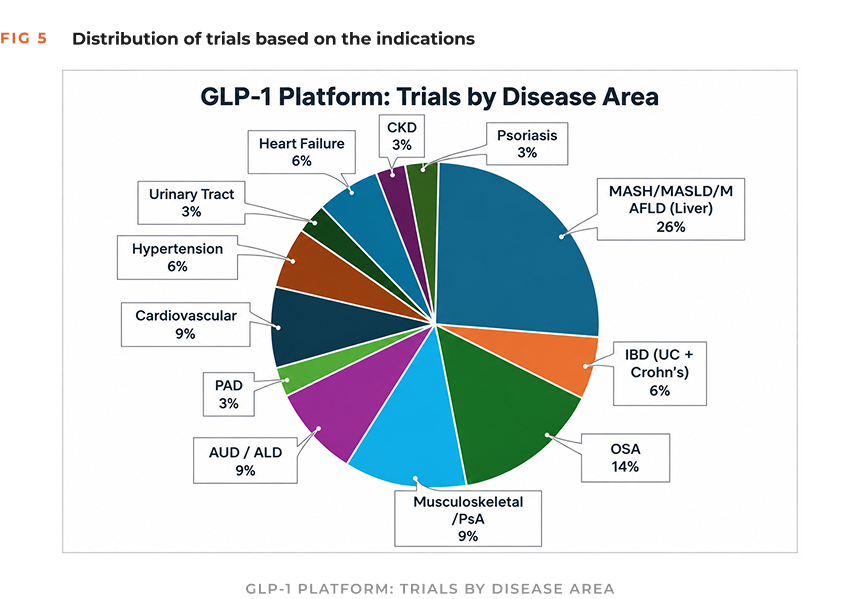
These approvals proved that GLP-1 benefits can reach well beyond the scale. The next wave is testing how far. Late-stage programs now span MASH, heart failure, peripheral arterial disease (PAD), osteoarthritis, inflammatory bowel disease, alcohol use disorder (AUD) and more (Fig. 3), turning GLP-1s from a drug class into a platform.
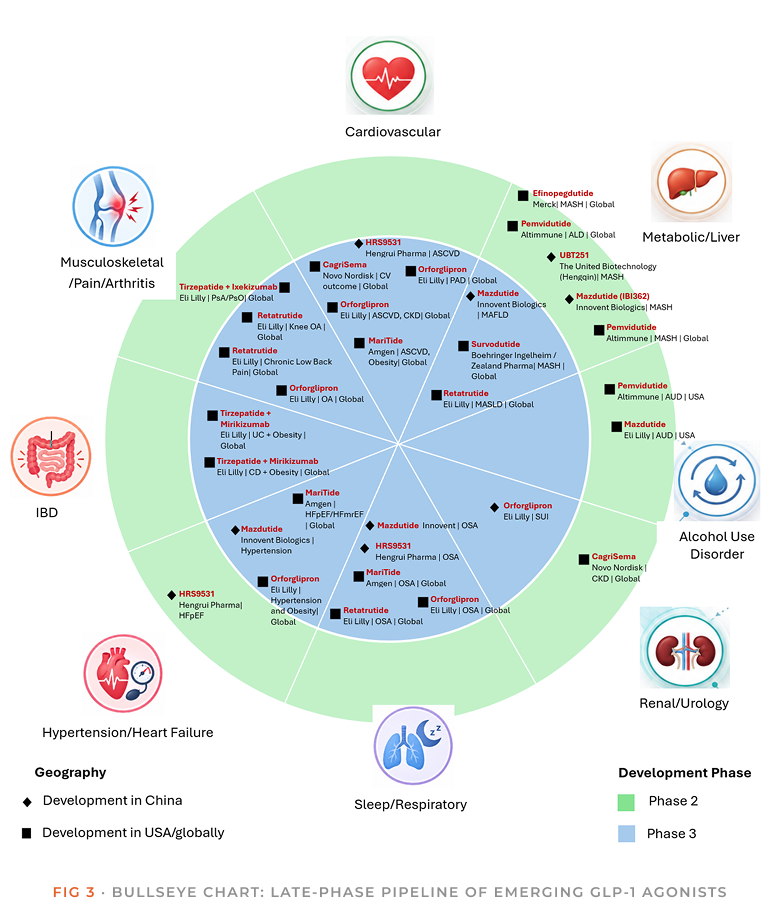
Data cut-off: Data shown reflects publicly available pipeline information as of July 2026.
Abbreviations: PsA: Psoriatic Arthritis; OA: Osteoarthritis; UC: Ulcerative Colitis; CD: Crohn's Disease; HFpEF: Heart failure with preserved ejection fraction; HFmrEF: Heart failure with mildly reduced ejection fraction; SUI: Stress Urinary Incontinence; OSA: Obstructive Sleep Apnea; ASCVD: Atherosclerotic Cardiovascular Disease; CKD: Chronic Kidney Disease; MASLD: Metabolic Dysfunction-Associated Steatotic Liver Disease; MAFLD: Metabolic Dysfunction-Associated Fatty Liver Disease; MASH: Metabolic Dysfunction-Associated Steatohepatitis; ALD: Alcohol-Associated Liver Disease; AUD: Alcohol Use Disorder; PAD: Peripheral Artery Disease
Pipeline Heatmap by Key Players: Phase III Presence by Therapeutic Area (✓ = Active Phase III Program)
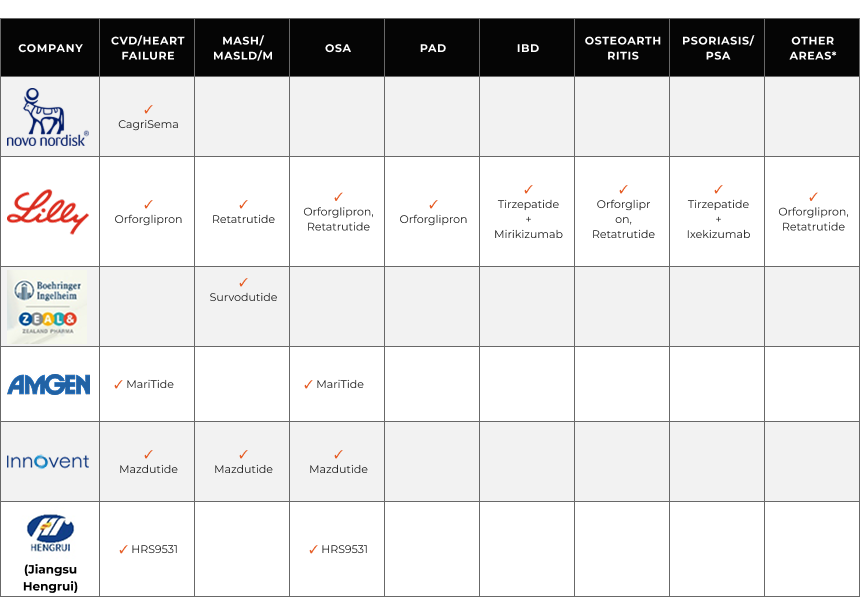
*Other Areas includes Stress Urinary Incontinence (SUI) & Chronic Low Back Pain
Key Learnings
- From one indication to a multi-organ platform. The pipeline has matured, with most programs now in late-stage development across cardiovascular, liver, inflammatory, musculoskeletal, sleep and addiction-related disease. Several readouts are expected between 2026 and 2031.Cardiovascular work has moved beyond reducing MACE to specific conditions: HFpEF, CKD, PAD, ASCVD and hypertension.MASH/MASLD is one of the most crowded spaces, with Survodutide, Retatrutide, Pemvidutide, UBT251 and Mazdutide in development.
- The battleground has shifted to receptor biology. As indications multiply, companies are competing on mechanism rather than on disease areas alone. Survodutide, CagriSema, MariTide, UBT251, HRS9531 and Retatrutide mark the move to dual- and triple-agonists. The COMMIT-UC and COMMIT-CD trials pair tirzepatide with the IL-23 inhibitor mirikizumab, which suggests GLP-1s may increasingly be one component of a regimen rather than a standalone therapy.
- Formulation is now a strategic choice. Most next-generation agents (CagriSema, MariTide, retatrutide, mazdutide, pemvidutide) are injectable peptides. They need complex peptide synthesis, sterile fill-finish, injection devices and cold-chain logistics. Orforglipron is an oral non-peptide, so it avoids the food-intake restrictions of peptide orals and can be made with conventional small-molecule processes.
- The race is no longer a duopoly, but Lilly is in a league of its own. Eli Lilly is the only company with Phase III programs in every therapeutic area tracked in Fig. 4. No other key player covers more than three, and Novo Nordisk has just one (CagriSema in CVD). Behind them, Amgen, Boehringer Ingelheim, Altimmune, Innovent, Hengrui and United Laboratories are advancing differentiated mechanisms.
- China stands out. Innovent's Mazdutide has the broadest Chinese late-stage pipeline, with Phase III programs in MAFLD, OSA and hypertension. Hengrui's HRS9531 is extending into cardiovascular disease, HFpEF and OSA, and United Laboratories' UBT251 into MASH.
- The brain remains unconquered. Expansion has stalled in neurodegeneration. Semaglutide's EVOKE and EVOKE Plus trials missed their primary endpoints in early Alzheimer's disease. Exenatide failed to show clinically meaningful disease modification in Parkinson's. Biological plausibility does not guarantee clinical benefit.
Current Limitations of GLP-1 Receptor Agonists
1. Tolerability is the first hurdle.
Nausea, vomiting, diarrhea and constipation are the most common adverse events and remain the primary class limitation.
2. Is it the drug or the weight loss?
Weight reduction alone can improve MASH, cardiovascular disease, CKD and OSA. That makes it hard to tell whether benefits in emerging indications are disease-specific. Further research is needed to separate the two.
3. Surrogate wins, unproven outcomes.
Most GLP-1 RA and dual-agonist MASH trials rely on biopsy or non-invasive imaging rather than hard outcomes such as mortality or transplant. A 2025 meta-analysis confirmed significant improvements in histologic resolution and fibrosis. Whether these translate into lower long-term morbidity and mortality is still unproven. Phase 2 dual-agonist trials (survodutide, pemvidutide) also run only 24–48 weeks, against a disease that progresses over years to decades.
4. Brain and behaviour signals are only partial.
In alcohol use disorder, semaglutide improved craving and drinks per drinking day. Average drinks per calendar day and number of drinking days did not change significantly. In Alzheimer's, liraglutide's ELAD trial missed its mechanism-based primary endpoint (cerebral glucose metabolism). CNS benefits remain a hypothesis.
5. Safety questions go beyond the gut.
A real-world study linked GLP-1 RAs, including liraglutide and semaglutide, to an increased risk of depression, anxiety and suicidal outcomes across dosages. This matters more as these drugs move into larger populations treated for longer.
Future Outlook
Multi-agonists could become the new standard of care
…as early evidence suggests stronger disease-specific efficacy. For instance, survodutide demonstrated histologic improvement in MASH without worsening of fibrosis in 83.0% of patients in a phase 2 trial. By comparison, semaglutide, a single GLP-1 receptor agonist, achieved 36.8% fibrosis improvement in the Phase III ESSENCE trial.
MASH is the nearest big prize.
Madrigal's Rezdiffra delivered 127% year-over-year sales growth in Q1 2026. That proves demand and creates a favourable environment for GLP-1 entrants.
Oral formulations could change access.
Orforglipron removes the injection and cold-chain barriers that limit uptake in lower-resource settings. It is a genuine threat to the injectable-first commercial model and a hedge against the manufacturing bottleneck.
Precision and combination regimens could replace one-size-fits-all.
Trials pairing GLP-1s with IL-23 inhibitors (COMMIT-UC, COMMIT-CD) point toward a future where GLP-1s are prescribed as part of a regimen selected by patient phenotype, not a one-size-fits-all monotherapy.
China could shape the next wave.
Innovent, Hengrui and United Laboratories are pushing multi-agonists into MASH, HF and OSA. Their out-licensing deals with Kailera Therapeutics and Novo Nordisk suggest China-originated assets may increasingly drive global GLP-1 innovation.
The first GLP-1 era answered one question: how much weight can a drug take off? The next era faces a harder one.
When a single drug class improves the heart, liver, kidneys, joints and sleep, is it treating many diseases, or showing us that many of them were one disease all along?
The answer will decide whether GLP-1s remain the best tool for treating obesity's consequences or become the backbone of chronic-disease medicine. The winners will be decided not only by trial readouts, but by manufacturing capacity, patient access and long-term safety data.
- Drucker DJ. Mechanisms of Action and Therapeutic Application of Glucagon-like Peptide-1. Cell Metabolism. 2018;27(4):740–756. https://www.cell.com/cell-metabolism/fulltext/S1550-4131(18)30179-7
- International Diabetes Federation. IDF Diabetes Atlas, 11th Edition. Brussels, Belgium: International Diabetes Federation; 2025. https://diabetesatlas.org/
- World Health Organization. Obesity and Overweight Fact Sheet. https://www.who.int/news-room/fact-sheets/detail/obesity-and-overweight
- Forbes Health. GLP-1 Statistics. https://www.forbes.com/health/weight-loss/glp-1-statistics/
- Drugs.com. Ozempic (Semaglutide): Uses, Dosage, Side Effects. https://www.drugs.com/ozempic.html
- Wilding JPH, et al. Once-Weekly Semaglutide in Adults with Overweight or Obesity. N Engl J Med. 2021;384:989–1002. https://www.nejm.org/doi/full/10.1056/NEJMoa2032183
- Jastreboff AM, et al. Tirzepatide Once Weekly for the Treatment of Obesity. N Engl J Med. 2022;387:205–216. https://www.nejm.org/doi/full/10.1056/NEJMoa2206038
- GLP-1 Receptor Agonists Beyond Diabetes: Emerging Multi-Organ Therapeutic Applications. PMC. https://pmc.ncbi.nlm.nih.gov/articles/PMC10778154/
- Emerging Clinical Landscape of GLP-1-Based Therapies Across Cardiometabolic and Chronic Diseases. PMC. https://pmc.ncbi.nlm.nih.gov/articles/PMC12873696/
- Zhang Y, et al. Psychiatric Safety of GLP-1 Receptor Agonists: A Real-World Pharmacovigilance Study. Scientific Reports. 2024. https://www.nature.com/articles/s41598-024-75965-2
- Endocrine Society. GLP-1 Receptor Agonists Show Promise in Treating Alcohol and Drug Addiction. 2025. https://www.endocrine.org/news-and-advocacy/news-room/2025/glp1s-show-promise-in-treating-alcohol-and-drug-addiction
- Emerging Evidence of GLP-1 Therapies in MASH and Alcohol Use Disorder. JHEP Reports. 2025. https://www.sciencedirect.com/science/article/pii/S258955592500391X
- Harrison SA, et al. Semaglutide for Metabolic Dysfunction-Associated Steatohepatitis with Moderate or Advanced Fibrosis. N Engl J Med. 2025. https://www.nejm.org/doi/full/10.1056/NEJMoa2401755
- U.S. Food and Drug Administration. Nonalcoholic Steatohepatitis with Compensated Cirrhosis: Developing Drugs for Treatment — Guidance for Industry. https://www.fda.gov/regulatory-information/search-fda-guidance-documents/nonalcoholic-steatohepatitis-compensated-cirrhosis-developing-drugs-treatment-guidance-industry
- U.S. Food and Drug Administration. Alcoholism: Developing Drugs for Treatment — Guidance for Industry. https://www.fda.gov/regulatory-information/search-fda-guidance-documents/alcoholism-developing-drugs-treatment
- The United Laboratories International Holdings Limited. Announcement, 24 February 2026. https://doc.irasia.com/listco/hk/unitedlab/announcement/a260224.pdf
- Sciwind Biosciences Co., Ltd. Pipeline. https://www.sciwindbio.com/portal/index/pipeline/category_id/3.html
- Eli Lilly and Company. FDA approves Lilly's Mounjaro (tirzepatide) injection as first-and-only medicine for adults with type 2 diabetes. 19 December 2025. https://investor.lilly.com/news-releases/news-release-details/fda-approves-lillys-mounjarotm-tirzepatide-injection-first-and
- Novo Nordisk A/S. News update, 20 June 2025. https://www.novonordisk.com/news-and-media/news-and-ir-materials/news-details.html?id=62112
- Eli Lilly and Company. Lilly's oral GLP-1 orforglipron successful in third Phase 3 trial. 17 April 2026. https://investor.lilly.com/news-releases/news-release-details/lillys-oral-glp-1-orforglipron-successful-third-phase-3-trial
- Lincoff AM, et al. Semaglutide and cardiovascular outcomes in obesity without diabetes. N Engl J Med. 2023;389(24):2221–2232. https://doi.org/10.1056/NEJMoa2307563
- Gan & Lee Pharmaceuticals. 1861-LB: Efficacy and safety of HRS9531, a novel GIP/GLP-1 receptor agonist, in Chinese adults with overweight or obesity. Diabetes. 2024;73(Suppl 1). https://diabetesjournals.org/diabetes/article/73/Supplement_1/1861-LB/155203/1861-LB-Efficacy-and-Safety-of-HRS9531-a-Novel
- Jastreboff AM, Aronne LJ, Ahmad NN, et al. Triple-hormone-receptor agonist retatrutide for obesity: a phase 2 trial. The Lancet. 2023;402(10402):613–626. https://www.thelancet.com/journals/lancet/article/PIIS0140-6736(23)01302-8/abstract
- Endocrine Society. Presentation information: ENDO 2026 Annual Meeting. https://endo2026.endocrine.org/
- Hansoh Pharma. Continuous innovation for better life. https://www.hansoh.cn/
- Eli Lilly to build new $3.5B injectable drug manufacturing site supporting GLP therapies in Pennsylvania. https://www.pharmaceuticalonline.com/doc/eli-lilly-to-build-new-b-injectable-drug-manufacturing-site-supporting-glp-therapies-in-pennsylvania-0001
- Novo Nordisk to invest $4.1 billion in expanding manufacturing capabilities in the United States. https://www.pharmexec.com/view/novo-nordisk-invest-4-1-billion-expanding-manufacturing-capabilities-united-states
- Novo Nordisk invests more than $2 billion in manufacturing facility expansion. https://www.pharmexec.com/view/novo-nordisk-invests-more-than-2-billion-in-manufacturing-facility-expansion
- Oral GLP-1s won't win on convenience — they'll win on CMC. The Medicine Maker. https://themedicinemaker.com
- Interview: GLP-1 demand and the new reality of device manufacturing capacity (Issue 186). ONdrugDelivery. https://ondrugdelivery.com/
- Retatrutide cost: what to expect when it hits the market. https://peptidenerds.com
- Eli Lilly and Company. Lilly's Taltz and Zepbound used together delivered superior efficacy in first-of-its-kind Phase 3b trial for adults with psoriasis and obesity or overweight. 18 February 2026. https://investor.lilly.com/news-releases/news-release-details/lillys-taltz-ixekizumab-and-zepbound-tirzepatide-used-together-0
- Eli Lilly and Company. Lilly's Taltz and Zepbound used together delivered superior efficacy in first-of-its-kind Phase 3b trial for adults with active psoriatic arthritis and obesity or overweight. 8 January 2026. https://investor.lilly.com/news-releases/news-release-details/lillys-taltz-ixekizumab-and-zepbound-tirzepatide-used-together
Prepared by PharmSight Research & Analytics for informational purposes only. It does not constitute medical advice.