2D cell line
Fast, simple
From self-organizing models to drug testing, regulatory science and regenerative medicine
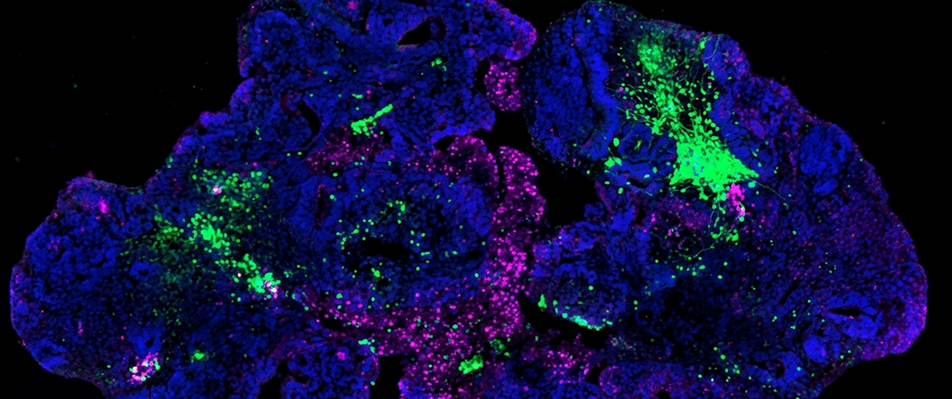
An organoid is a three-dimensional structure generated from pluripotent or tissue-resident stem cells that self-organize and reproduces selected structural, cellular and functional features of its tissue of origin.
It is not a miniature, fully functioning organ. Its relevance depends on the biological question and the assay's context of use.
Organoids add three-dimensional, tissue-specific biology between simplified cell assays and whole-organism studies.
Self-organizing architecture and cell–cell interaction
Human or patient-derived biological context
Expandable models for repeated perturbation and screening
Fifteen years ago, organoids were a developmental-biology curiosity. Today they sit at the intersection of drug discovery, precision oncology, and a regulatory revolution that is rewriting how new medicines reach patients.
Organoids occupy a middle ground: more human-relevant than reductionist assays, more scalable than whole-organism models, but not a complete model of human biology.
The modern field accelerated after pluripotent-stem-cell advances and the 2009 intestinal-organoid breakthrough
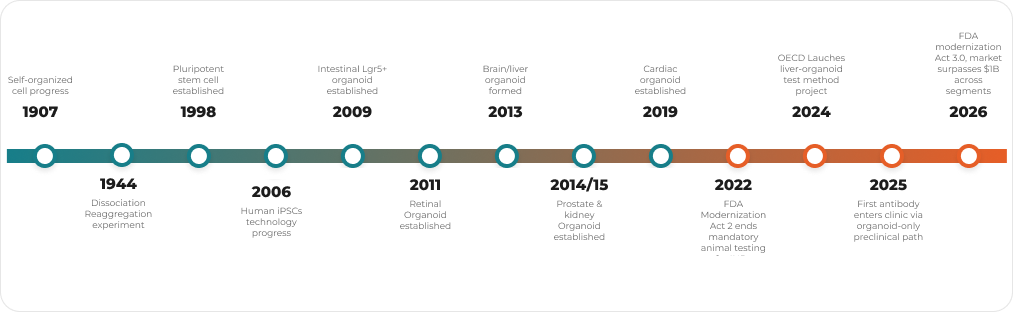
The same history also explains why formation strategy matters: organoids inherit different strengths and limitations from the cells and culture cues used to build them.
Organoids are most valuable when traditional models cannot accurately mimic human biology
| Disease domain | Representative organoid examples | What the model can reveal |
|---|---|---|
| Genetic developmental | Microcephaly; DNAJC6-associated Parkinson's disease; APOE4 Alzheimer's disease; CRX-Leber congenital amaurosis; polycystic kidney disease | Helps understand how genetic mutations affect human organ development, identify disease mechanisms, and evaluate potential gene correction or targeted therapies |
| Infectious disease | Zika and SARS-CoV-2 brain models; SARS-CoV-2 nasal and distal-lung models; Pseudomonas airway models; intestinal host–microbe systems | Shows how microorganisms infect human tissues, spread between cells, damage organs, and trigger the body's immune response |
| Inflammatory & autoimmune | Inflammatory bowel disease; Hashimoto's thyroiditis; Graves' hyperthyroidism | Reveals how immune cells interact with tissues, why inflammation occurs, how patients differ in disease biology, and which treatments may work best |
| Metabolic & toxic injury | Diabetic vasculopathy; alcohol-related liver disease; drug-induced liver injury; kidney nephrotoxicity | Demonstrates how metabolic disorders or drugs damage specific organs, identifies early signs of toxicity, and compares diseased tissue with healthy tissue |
| Cardiovascular | Myocardial infarction and hypoplastic left-heart syndrome | Helps study changes in heart structure and function, understand disease progression, and evaluate how the heart responds to potential therapies |
| Cancer | Glioblastoma, retinoblastoma, lung, colorectal, gastric, pancreatic, gallbladder and ovarian cancers | Recreates patient tumors to study tumor biology, genetic diversity, drug sensitivity and resistance, enabling personalized treatment selection and biomarker discovery |
“One antibody went from an idea to human patients in two and a half years, based on organoid testing alone — with no animal or cell lines involved.”— Hans Clevers, Roche Institute of Human Biology
Recapitulating one disease feature is not equivalent to reproducing the complete disease. Model validity must be linked to the specific mechanism or decision being tested.
Organoid-guided trials are expanding across cancers, demonstrating growing confidence in their role in personalized medicine and clinical decision-making
| Disease | Objectives | Phase | Status | Start | Trial ID |
|---|---|---|---|---|---|
| Gastric Cancer | Generate patient-derived gastric organoids to test the effects of pyrvinium | Phase 2 | Recruiting | Dec-2025 | NCT06590454 |
| Wilms Tumor | Develop organoid models to study Wilms tumor and compare responses to chemotherapeutic agents | Phase 2 | Recruiting | Aug-2021 | NCT04968990 |
| Colorectal Cancer | Individualized treatment using pharmacogenomics and patient-derived organoids in metastatic colorectal cancer | Phase 2 | Recruiting | Sep-2022 | NCT05725200 |
| Thyroid Carcinoma | Organoid-guided precision medicine in locally advanced thyroid cancer | Phase 2 | Recruiting | Jun-2021 | NCT06482086 |
| Pancreatic Cancer | Adaptive organoid-based precision therapy study in pancreatic cancer | Phase 2 | Recruiting | Jul-2022 | NCT06813079 |
| Breast Cancer | Patient-derived organoid-guided personalized therapy vs physician's choice in relapsed/refractory breast cancer | Phase 3 | Recruiting | Jan-2024 | NCT06266652 |
| Small Cell Lung CancerSCLC | Organoid-guided vs topotecan therapy in relapsed extensive-stage SCLC | Phase 3 | Not yet recruiting | Jul-2025 | NCT07106628 |
Furthermore, recent advances in regenerative medicine have moved organoid transplantation from experimental models toward clinical application.

These milestones illustrate the evolution of organoids from laboratory models to therapeutic products, marking an important step toward regenerative medicine and organ replacement therapies.
The direction is clear; the acceptable evidence package remains product-, endpoint- and context-specific.
Define the specific purpose and decision the model is intended to support.
Demonstrate that the model accurately reflects key aspects of human biology and disease.
Establish the model's reproducibility and performance using standardized methods.
Provide evidence that the model is suitable for its intended regulatory or research application.
Policy signal: NAM evidence is actively encouraged, and formal validation expectations are emerging.
Development option: Some animal studies may be reduced, refined or replaced where equivalent or better evidence exists.
Strategic priority: Assay qualification and early regulatory dialogue become valuable capabilities.
No universal waiver: Organoids do not automatically replace systemic or long-duration evidence.
No platform-wide acceptance: Validation is tied to a specific endpoint and context of use.
Clinical trials remain: Human efficacy and safety evaluation are not removed by an organoid-enabled preclinical package.
The relevant question is not “Does FDA accept organoids?” It is “Can this assay reliably answer this regulatory question in this product context?”
Industry leaders are investing in organoid capabilities to improve translational predictability, enable precision medicine and accelerate drug development.
| Company | Strategy | Example |
|---|---|---|
| Roche / Genentech | In-house discovery institute, founder-led | The Roche Institute of Human Biology (IHB), founded around organoid pioneer Hans Clevers, took a novel antibody from concept to first-in-human trials in 2.5 years using organoid data alone, without conventional animal or 2D cell-line testing. |
| Merck KGaAMilliporeSigma | Platform built via acquisition | Acquired HUB Organoids (deal closed Dec 2024, ~€104M/$120M) for its gastrointestinal, lung and pancreatic organoid biobanks, then partnered with Promega (Oct 2025) to build real-time reporter assays inside organoid cultures. |
| GSK | Acquisition + first-of-kind clinical trial | Acquired CELLphenomics (2024) for its patient-derived organoid platform; now running what it describes as the first trial combining organoids, AI and imaging as “digital biological twins,” growing organoids from ~200 NHS non-small-cell lung cancer patients with King's College London. |
| AstraZeneca | Academic-consortium biobank building | Built new lung-cancer organoid models with Royal Papworth Hospital, the Wellcome Sanger Institute and the Human Cancer Models Initiative to cover mutation subtypes no existing preclinical model captured. |
| Boehringer Ingelheim | In-house global oncology hub | BI's Vienna cancer hub has used organoids since roughly 2019; it is now converting its patient-derived xenograft (PDX) mouse-model bank into organoid panels with Charles River, aiming for PDX-level tumor diversity without the animal. |
| Vertex Pharmaceuticals | Regulatory-grade biomarker in rare disease | Uses patient rectal/intestinal organoid “theratyping” to test CFTR modulators against mutations too rare for clinical trials; this organoid-derived functional data has supported regulatory label expansions of its CFTR modulators to thousands of rare-genotype cystic fibrosis patients. |
Organoids trade whole-body completeness for human relevance, manipulability and scale.
| Constraint | Why it matters | Development response |
|---|---|---|
| Incomplete microenvironment | Many models lack stroma, immune cells, endothelium, nerves or organ–organ interaction. | Co-culture, vascularization, microfluidics and multi-organoid systems |
| Immaturity | PSC-derived models often resemble fetal rather than adult tissue. | Longer culture, bioreactors, transplantation and maturation cues |
| Reproducibility | Patient, protocol, cytokine, matrix and cell-composition variation affects results. | Reference standards, automation, defined media and release criteria |
| Matrix dependence | Matrigel and related animal-derived products vary by batch and are poorly suited to transplantation. | Defined synthetic, biomimetic and decellularized-tissue hydrogels |
| Throughput & economics | Complex culture, imaging and analytics can constrain scale and turnaround. | Miniaturization, robotics, high-content imaging and AI |
| Clinical safety & ethics | Tumorigenicity, off-target cells, immune risk and brain-organoid ethics require governance. | GMP-compatible processes, long-term testing, transparent oversight and context-specific ethics |
Organoids complement rather than universally replace cell lines, animals or clinical evidence. Their value is highest when the model's limitations are explicit and matched to the decision.
Success will be measured by reproducibility and decision impact, not by anatomical resemblance alone.
Organoids: Powerful Through Precision,
Not Perfection
Prepared by PharmSight Research & Analytics for informational purposes only.