From Drug-Centric to Patient-Centric: Rethinking Clinical Trials.

What if the biggest challenge in clinical trial success is no longer science, but participation?
Clinical trials are built to answer scientific questions. Protocols define endpoints, statistical frameworks determine the evidence required, and safety is closely monitored.
But there is another question that deserves equal attention:
Can patients realistically participate in the trial we have designed—and stay in it?
That question is not simply about patient experience. It has direct implications for recruitment, retention, diversity, and ultimately the quality of the evidence generated.
A large-scale analysis of 28,561 clinical trials registered on ClinicalTrials.gov found that insufficient enrollment was the most common reason for trial stoppage, accounting for 36.7% of stopped trials.
Recruitment is not just an operational challenge. It is a design challenge.
The Hidden Cost of a Protocol
When development teams look at a protocol, they see scientific and operational requirements.
Patients experience something else:
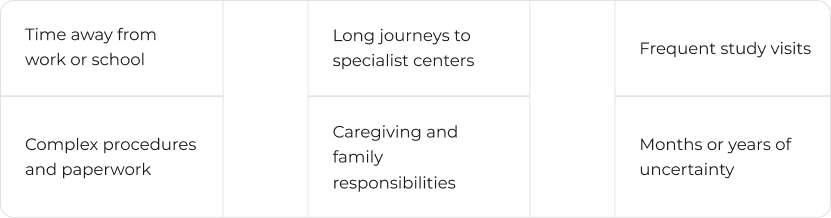
Each requirement may be reasonable on its own. The cumulative burden is what determines whether participation is sustainable.
Consider a working parent enrolled in a clinical trial. A single site visit could mean taking time off work, arranging childcare, traveling several hours to a specialist center, and spending most of the day undergoing assessments.
For patients, burden is not an abstraction. It is a line item in their week.
In a national U.S. survey, 55% of respondents said cost-related considerations—including travel, lost wages, and out-of-pocket expenses—were very influential in their decision to join a clinical trial.
And the consequences extend beyond convenience.
When participation becomes harder, recruitment slows. Retention suffers. Patients who live far from research centers, have caregiving responsibilities, or face mobility and logistical constraints may be excluded—not because they lack interest, but because the protocol is difficult to sustain.
A scientifically rigorous trial can therefore still produce evidence that does not fully represent the patients who will ultimately use the therapy.
Design the Protocol Around What the Science Actually Requires
Clinical development rightly starts with scientific questions:
What endpoints matter? What statistical power is required? Which assessments are necessary?
But one more question should be asked before the protocol is finalized:
Would a patient realistically be willing and able to live with this protocol?
A simple design filter can help:
Is this requirement scientifically necessary to answer the primary question?
If not, remove it.
Can the same information be collected in a less burdensome way?
Consider remote, local, or less frequent approaches where scientifically appropriate.
Can patients realistically sustain this requirement for the full duration of the study?
If not, bring patient input into the design before the protocol is locked.
The objective is not to make trials easier at the expense of rigor. It is to preserve the science while removing unnecessary friction.
Technology Can Reduce Friction—But It Cannot Replace Science
Telehealth, wearables, remote monitoring, digital platforms, and AI create new opportunities to make trials more accessible. The FDA's 2024 final guidance on decentralized clinical trial elements provides sponsors with a clearer regulatory path to incorporate these approaches. Maddiboyina, Clinical Leader, 2025
But technology should not become another layer of burden.
In oncology, for example, imaging may be central to the primary endpoint. A wearable cannot replace an imaging scan, and remote monitoring cannot eliminate every site visit.
The goal is more nuanced:
Keep patients at the site when the science requires it—and remove the journey when it doesn't.
Where this approach has been applied, the impact can be meaningful. A fully decentralized Phase 4 oncology trial replaced routine in-person visits with telehealth, mobile nursing, and electronic patient-reported outcomes and achieved a 96% retention rate, compared with approximately 70% typical retention in site-based oncology trials.
But decentralization is not automatically patient-centric. Replacing a six-hour hospital journey with multiple apps, devices, passwords, and repetitive questionnaires simply shifts the burden from the physical world to the digital one.
The right question is therefore not:
“Can this assessment be done remotely?”
“Does this assessment need a site—and will moving it elsewhere genuinely make participation easier?”
Patient-Centricity Is Also About What We Measure
Making participation easier is only one dimension of patient-centric clinical development. The other is whether the trial measures outcomes that matter to patients.
Clinical endpoints such as response rates, progression-free survival, and overall survival remain essential. But patients may define meaningful benefit through outcomes closer to everyday life: less pain, greater mobility, better sleep, reduced fatigue, or more time with family.
Patient-reported outcomes (PROs) provide a structured way to capture these experiences alongside clinical endpoints.
Regulators already recognize their importance. PROs were included in roughly 75% of registration trials supporting the 55 new oncology drugs approved by the FDA between 2014 and 2018.
A treatment can demonstrate statistical significance on its primary endpoint while leaving important aspects of a patient's daily life unchanged. Clinical benefit and patient experience are not competing concepts. They are complementary dimensions of treatment value.
Rare Diseases Make the Challenge More Visible
The consequences of site-centric trial design become even more pronounced in rare diseases.
Rare disease patients often travel significantly farther to access specialized care and clinical trials, with travel distances reaching approximately 270 miles round trip, reflecting the scarcity of expert trial sites and concentrated treatment centers. Applied Clinical Trials, 2024
For patients and caregivers, that distance can determine whether participation is feasible.
Hybrid and decentralized models will not eliminate the need for research sites. Instead, they can help ensure that patients travel when there is a compelling scientific or clinical reason to do so—and have an alternative when there isn't.
Patient Input Should Start Before the Protocol Is Locked
One of the most important shifts is also one of the simplest: Ask patients earlier.
Patient perspectives are often sought after eligibility criteria, visit schedules, and other core protocol decisions have already been established.
Instead, ask before those decisions are finalized:
“What would make you say no to participating in this study?”
The answers can reveal barriers that traditional operational feasibility assessments may miss.
And importantly, they can be addressed when changes are still relatively inexpensive.
Earlier patient input can influence visit frequency, visit duration, procedures, travel requirements, digital tools, and the way outcomes are captured—before these decisions become embedded in the protocol.
This Is Already Happening.
Patient-centric protocol design is not simply an aspirational concept.
The FDA's Patient-Focused Drug Development (PFDD) guidance series provides a structured framework for incorporating patient experience data into drug development and regulatory decision-making.
TransCelerate Biopharma developed the Patient Protocol Engagement Toolkit (P-PET) to bring patients and caregivers into protocol development before finalization. Documented use cases have reported fewer screening failures, fewer dropouts, higher enrollment, and zero avoidable protocol amendments following changes such as reducing visit duration and frequency and introducing electronic patient-reported outcomes.
Large pharmaceutical organizations have also institutionalized patient engagement. GSK runs a “Patients in Partnership” program. Sanofi created a Chief Patient Officer role, Janssen maintains a Global Patient Engagement function, and Eli Lilly has empowered study teams to incorporate patient-centricity into protocol design.
The message is clear: Patient-centricity is moving from a principle to a clinical development capability.
A New Dimension of Clinical Development
For decades, pharmaceutical innovation has followed a familiar pathway:

A patient-centered model adds another dimension:

Because the strongest science still depends on people being able—and willing—to participate.
The industry already invests heavily in optimizing recruitment models, site performance, monitoring, and data systems.
The next opportunity is more fundamental: Optimize the experience of being a trial participant. That does not mean compromising scientific rigor. It means asking, at every stage of protocol design:
The organizations that answer those questions early will not only make trials more patient-friendly.
They may build trials that recruit faster, retain better, represent patients more broadly, and generate evidence that is closer to the real world.
Clinical trials were designed to evaluate drugs. The next generation of clinical development will design them around the people who make those trials possible.